

The Rise of the Zombie Agency
Unless one was living under a rock, one would know that a Supernova erupted in the first week of January 2026, signalling the end of the World Law and Economic Order as we know it. The shockwaves created, especially in the areas of the environment, society, governance (ESG), and climate change, will have a significant impact on the management accounting profession.
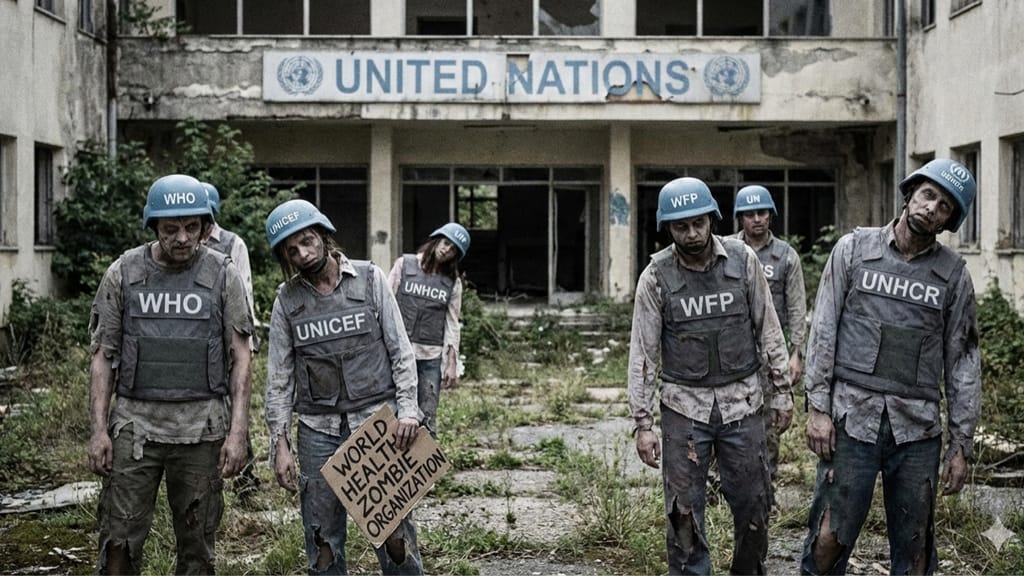
Today, the international agencies responsible for enforcing rules-based law and order, such as those in the fields of economics, finance, international trade, health, sovereignty rights, and the environment, have transformed into ‘Zombie Agencies’, possessing no power against a rampant superpower determined to uphold its ‘might is right’ philosophy. Every day, more and more knives are driven into these United Nations (UN) and non-UN Agencies, but like the Zombies in the ‘Friday the 13th’ movies, you cannot kill them because they are already dead!
Actually, the first knife was driven on April 2, 2025, when US President Donald Trump unveiled his “Liberation Day” tariffs. But at that time, the international agencies governing trade did not immediately die, thanks to another superpower, China, countering these tariffs with their own similarly supercharged ones.
Further knives were inserted in agencies tasked with implementing rules-based law and order in June 2025, when the United States unilaterally conducted airstrikes on three Iranian nuclear facilities (Fordo, Natanz, and Isfahan) using GBU-57 Massive Ordnance Penetrators (MOP). The US used these 30,000-pound “bunker buster” bombs, the largest non-nuclear bombs in its arsenal, in an operation known as “Operation Midnight Hammer”.
By bombing another country without declaring war, International Humanitarian Law (IHL), also known as the Laws of War, particularly the Geneva Conventions and Hague Rules, was completely ignored. The UN did not approve the dropping of bombs on Iran in 2025; in fact, UN Secretary-General António Guterres said that he was “gravely alarmed by the use of force by the United States against Iran and that this was a dangerous escalation in a region already on the edge – and a direct threat to international peace and security.”
On December 10, 2025, the United States inserted a sharper knife more deeply into rules-based law-and-order agencies by boarding and seizing an oil tanker linked to Venezuela, specifically the vessel Skipper, off the coast of Venezuela. The seizure was framed as part of a U.S. operation to enforce sanctions on Venezuela’s oil trade, which the U.S. government views as a way to finance illicit drug-related activities. The Skipper, a very large crude carrier, was allegedly part of a “shadow fleet”, and the US claimed it was falsely flying the flag of Guyana at the time of its capture.
The international law that applied in the case of this action, according to legal analysts and US justification, was the United Nations Convention on the Law of the Sea (UNCLOS) Article 110, which specifically gives the right to board a vessel deemed “without nationality” or flying a false flag.
Venezuela condemned the seizure as an “act of international piracy” and a violation of the UN Charter, arguing the US had no jurisdiction to enforce its laws on non-US persons or vessels outside its territory without a UN Security Council mandate.
However, the knife that finally killed all pretexts that we still live in a rules-based world was inserted on 3 January 2026, when the United States launched military strikes on Venezuela and kidnapped President Nicolás Maduro and his wife, Cilia Flores, in an operation codenamed ‘Operation Absolute Resolve’.
Commentators were quick to describe the US strikes in Venezuela as a breach of article 2(4) of the UN charter, stating that the US’ actions are only lawful if supported by a resolution from the UN Security Council, or if the US was acting in self-defence, or if there was consent by the lawful government of Venezuela to the intervention (McKelvie, 2026).
There was no UN Security Council authorisation for the US to intervene in Venezuela, nor had the US been the victim of an ongoing or imminent act of aggression by Venezuela, and there certainly was no consent given by the government of Venezuela.
Some purists still claim that international law is alive, even though the most powerful nation no longer respects it. They argue that breaches of the law are normal in any legal system. Indeed, they are expected, they argue; otherwise, the rule would be unnecessary.
Their view is that international law is created by all states, not just the powerful few. This makes international community reactions to breaches particularly important, they claim. Thus, to preserve the rules-based international order, these purists implore all states to call out breaches of the law when they occur, including in the current instance of the kidnapping (Heathcote, 2026).
But what if the UN agencies, designed to address breaches of law and order, are now ineffective—worse than toothless tigers—because they have been reduced to Zombies, unaware that they are now the walking dead?
When Might is Right.
The US president has openly admitted that his ambition in Venezuela is to turn a profit from its oil and is now demanding control of Greenland (“whether they like it or not”) in the hope of painting the world map with the US stars and stripes. All pretexts of controlling drugs and sanctioned oil have been abandoned.
The Trump vision comes with proof of his willingness to deploy hard power, rather than merely posting “truths” on social media, to get his way. It shakes old alliances because it comes with a signal that he could use force against others – even NATO members – if they do not submit to his plans (Crowe, 2026).
It feels like a new world disorder. The sense of balance in world politics is shifting, and a new era of great power competition is underway. In this world, “might is right”.
Despite their belief in a similar worldview, Chinese President Xi Jinping and Russian President Vladimir Putin have largely acted within the boundaries of international law and order—up to this point. It is President Trump who must single-handedly be given credit for the death of the world’s rules-based law and economic order as we knew it in the past.
Clearly, we now have an era where major rivals seek to impose their will across their ‘spheres of influence’. American allies, such as Australia, must adapt because they have no choice but to survive in this new dispensation. “If you’re not running a sphere of influence, you’re in one” (Crowe, 2026).
There are four major powers in this world view: the United States, China, Russia and India. Although Russia’s nominal GDP typically puts it behind major EU nations like Germany, France, and the UK, it is a nuclear state that is aggressive in using its military. Two of the four superpowers, Russia and China, are considered ‘rogue states’ by the western media, but, as mentioned earlier, they have behaved, up to now, within acceptable tolerances of international law and order. It is the United States that has gone full-rogue by undermining very directly the politics of countries around it without any consideration for rules-based law and order.
The New Ethos for Using Power
President Trump has the power, and he has demonstrated that he will use it as he wants. In fact, one of the President’s most dedicated acolytes, Mr Stephen Miller, the White House deputy chief of staff, said as much this week (Tingle, 2026).
“We live in a world in which you can talk all you want about international niceties and everything else,” he told CNN on January 6, 2026. “But we live in a world, in the real world, that is governed by strength, that is governed by force, that is governed by power. These are the iron laws of the world.”
Miller was direct about the rationale for intervening in Venezuela.
“The US is using its military to secure our interests unapologetically in our hemisphere,” he said. “We’re a superpower, and under President Trump, we are going to conduct ourselves as a superpower.”
Probably in response, French President Emmanuel Macron shattered the traditional façade of America as a dependable ally. He spoke on January 8, 2026, in Paris about the danger of the US “turning away from some of its allies” and “freeing itself” from international rules.
“It’s the greatest disorder, the law of the strongest, and everyday people wonder whether Greenland will be invaded, whether Canada will be under the threat of becoming the 51st state or whether Taiwan is to be further circled,” Macron told French diplomats, in remarks reported by the Associated Press (AP Newsroom, 2026).
He foresaw a “dysfunctional” era where major powers like the US and China would be tempted to divide the world among themselves.
Venezuela: A Precedent for China?
How China responds is now a key factor in the aftermath of the US operation in Venezuela, but some commentators believe that there are flaws to the theory that President Xi will be emboldened to copy President Trump and send Chinese special forces into Taiwan. This is because they argue that Beijing would know it is an extremely difficult operation, and they would not be reckless about it. They would know all of the ramifications and risks if it went wrong – and there are many, many ways in which it could go wrong (Visentin, 2026).
The wider, longer-term impact of President Trump asserting his personal power is that by blowing up the international rule-based order, he is speeding up China’s resolve to be a superpower to rival America. The Chinese economy is growing; its people are steadily becoming wealthier; money is pouring into the Chinese defence forces; and Beijing is determined to assert itself in Asia and the world. Beijing will perceive the USA’s actions as a confirmation that their time is approaching more rapidly than they initially anticipated.
The facts are that major powers will always prioritise national interests over international laws. As the two great powers selectively decide which rules apply to them, Beijing will surely be content to see the US tied up in arenas it has no desire to enter into, while America’s partners grow increasingly uncomfortable at the actions of their ally.
This means the future is all about competing spheres of influence because none of the actions by the Trump White House block China from increasing its power. Consequently, nations across Asia may need to rethink the wisdom of being aligned with Washington, DC, when the leader in the White House is such an unreliable ally. Europe may need to consider the unthinkable: inviting Russia to join NATO. After all, as spoken by Michael Corleone in the Godfather Part II movie, “Keep your friends close, but your enemies closer.
If America persists with its current behaviour, it will no longer be able to function as a significant force in Europe or Asia within the next decade, as countries in these regions will begin to make their own decisions about their alliances. Recent actions have demonstrated to the outside world, friends and foes alike, that they cannot make any assumptions about America’s role going forward.
Attacks on the Zombie Agencies Continue
The Rules-based order is dead. The UN agencies are the walking-dead. But President Trump continues to stab them in new ways on a daily basis. On January 9, 2026, he pulled the US out of 66 international organisations that he deemed “wasteful, ineffective, or harmful.” The list included 31 UN organisations and 35 non-UN organisations, all deemed contrary to the interests of the United States to remain a member of, participate in, or otherwise provide support for.
Almost half of those 66 organisations are devoted to upholding international law and protecting women and children from violence. These organisations, according to US Secretary of State Marco Rubio, now advance agendas that are “contrary” to the US. The organisations on the list, he said, were taking the “blood, sweat and treasure of the American people”.
A White House fact sheet contended those groups operated contrary to US national interests, security, economic prosperity, or sovereignty. Many of these bodies, as the White House claimed, promote radical climate policies, global governance, and ideological programmes that conflict with US sovereignty and economic strength. “By exiting these entities, President Trump is saving taxpayer money and refocusing resources on America First priorities” (Morris-Grant, 2026).
According to the presidential memorandum and White House announcements, the list is divided into two categories: 31 UN bodies and 35 non-UN organisations. This distinction was explicitly outlined in the official releases to highlight the broad scope of the policy beyond just UN-affiliated groups.
The Details of the Withdrawal
The presidential memorandum, released by the White House, specifies that the withdrawals are intended to eliminate U.S. involvement in entities that “advance globalist agendas over U.S. priorities.” Among the 31 UN bodies targeted are key programmes focused on climate change, population, women’s rights, energy, and water resources. Notable examples include:
- The United Nations Framework Convention on Climate Change (UNFCCC), the foundational treaty for global climate action signed in 1992.
- The UN Population Fund (UNFPA), which addresses reproductive health and population issues.
- UN Women, dedicated to gender equality and women’s empowerment.
- UN Energy and UN Water, which coordinate international efforts on sustainable energy and water management.
The 35 non-UN organisations span a wide range, including the Intergovernmental Panel on Climate Change (IPCC), the Partnership for Atlantic Cooperation, and the International Institute for Democracy and Electoral Assistance. These bodies cover areas like climate science, democratic governance, migration, and labour standards. The US State Department, in an accompanying release, described these institutions as “redundant, mismanaged, unnecessary, or poorly run”, justifying the cuts as a means to redirect resources towards domestic priorities.
A review of the full list found at least 16 groups focusing on climate change and the environment and 14 focused on international law, peacekeeping and protection of vulnerable groups.
Of much concern to management accountants was that one of the agreements included on the list is the UN Framework Convention on Climate Change (UNFCCC), which has been in place for more than three decades. The agreement, signed by 198 countries, serves as the baseline for the landmark Paris Agreement, a legally binding treaty to limit global warming.
President Trump pulled the US out of that agreement during his first term in 2016, then again in 2025, just hours after his second inauguration. The withdrawal will become official later this month, one year after the formal notification. His decision made the US one of just four countries not included in the Paris Agreement—alongside Iran, Libya, and Yemen.
At the same time, he suspended support for the World Health Organisation (WHO) and other UN agencies. The focus of five additional groups was on curbing international security threats, counterterrorism, and cybercrime.
In his statement this week, Secretary of State Marco Rubio said the organisations were “often dominated by progressive ideology” and “detached from national interests.”
“[What] started as a pragmatic framework of international organisations for peace and cooperation has morphed into a sprawling architecture of global governance,” he said.
President Trump has indicated that there will be more agencies that the US will withdraw from. But it does not matter how many agencies the US withdraws from. The moment the US walked away from any pretext of upholding rule-based law and espoused the view that “might is right”, all these agencies became Zombies. No matter how many knives are stuck into them, you cannot kill them, as they are already dead.
Conclusion
The events of early 2026 have dramatically underscored the erosion of the rules-based international order, with the United States at the forefront of this seismic shift. The metaphor of “Zombie Agencies” aptly encapsulates the current state of global governance institutions, which now function as powerless entities in the face of aggressive unilateral actions by dominant superpowers. The U.S., under President Trump, has decisively abandoned international norms, opting instead for a “might is right” strategy that disregards established laws and multilateral agreements.
The abandonment of international law by the U.S. is reshaping global dynamics and accelerating the rise of other major powers, particularly China, which sees an opportunity to assert its influence more robustly. This shift has implications for global alliances, as traditional U.S. allies reconsider their positions in an increasingly unpredictable geopolitical landscape. As the U.S. withdraws from international organisations and treaties, the global community is left grappling with the reality of a new world disorder, where power dynamics are redefined, and the future of multilateral cooperation, if not dead, hangs precariously in the balance.
Ultimately, the current trajectory suggests a world moving towards competing spheres of influence, where national interests overshadow collective global governance. The challenge now lies in how the international community will respond to these changes and whether it can adapt to preserve any semblance of a cooperative global order amid the prevailing ethos of unilateralism and power politics.
References
AP Newsroom (2026), “Senior European officials express concern following US comments on Greenland’, Associated Press, January 9, https://newsroom.ap.org/editorial-photos-videos/detail?itemid=6687eef081cb4de599b3766ed7f0622e&mediatype=video
Crowe, David (2026) “Divide and Conquer”, The Age, Insight, January 10, Pages 33,36-37.
Heathcote, Sarah (2026), “Were the US actions in Venezuela legal u er international law? An expert explains”, The Conversation, January 4. https://theconversation.com/were-the-us-actions-in-venezuela-legal-u er-international-law-an-expert-explains-272684
McKelvie, Geraldine (2026), “Is there any legal justification for the US attack on Venezuela? The Guardian, January 4. https://www.theguardian.com/world/2026/jan/03/is-there-any-legal-justification-for-the-us-attack-on-venezuela-trump-maduro
Morris-Grant, Brianna (2026), “Donald Trump pulls US out of dozens of international organisations on environment and security’, ABC News, January 9. https://www.abc.net.au/news/2026-01-09/us-withdrawal-trump-united-nations-organisations/106210134
Tingle, Laura (2026), “Donald Trump is reshaping American power and the threat to international order is alarming”, ABC News, January 9, https://www.abc.net.au/news/2026-01-10/trump-power-ABC News, January 9, venezuela-greenland-international-law-morality/106214406
Visentin, Lisa (2026), “Discomforting moment for Beijing, caught on camera hours before Trump’s raid’, Sydney Morning Herald, January 7, https://www.smh.com.au/world/asia/why-trump-s-venezuela-gambit-will-not-change-beijing-s-calculus-on-taiwan-20260107-p5ns89.html