


Written by : Dr Chris D’Souza – Deputy CEO and CFO of of ICMA (ANZ).
“It is not the strongest of the species that survives, nor the most intelligent, but the one most responsive to change.” Charles Darwin (1859, as cited in Megginson, 1963, p. 4)
‘I planned each charted course, each careful step along the byway / And more, much more than this, I did it my way.’ (Anka, 1969)
Frank Sinatra first sang these words in 1969, not as a boast but as a reckoning. The song is built around a man reckoning with a life of imperfect decisions, uncertain conditions, and roads that could not be fully mapped in advance and finding in that reflection not regret, but clarity. He did not claim the course was always correct. He claimed the commitment was always total.
It is, underneath the music, a philosophy of leadership. And it is one that most leadership frameworks have never quite managed to articulate – because it requires accepting something deeply uncomfortable: that certainty is not a precondition for commitment. That the conditions will never be perfect. And that the quality of a leader is not measured by the circumstances they inherit but by the fullness with which they engage with the ones that actually exist.
This article is about that kind of leadership. And about the decisions – personal, professional, and strategic – that reveal whether a leader is genuinely playing the game in front of them or spending their energy mourning the one they wish they had been playing.
The Parable of the Crossroads: On Decisions That Cannot Be Undone
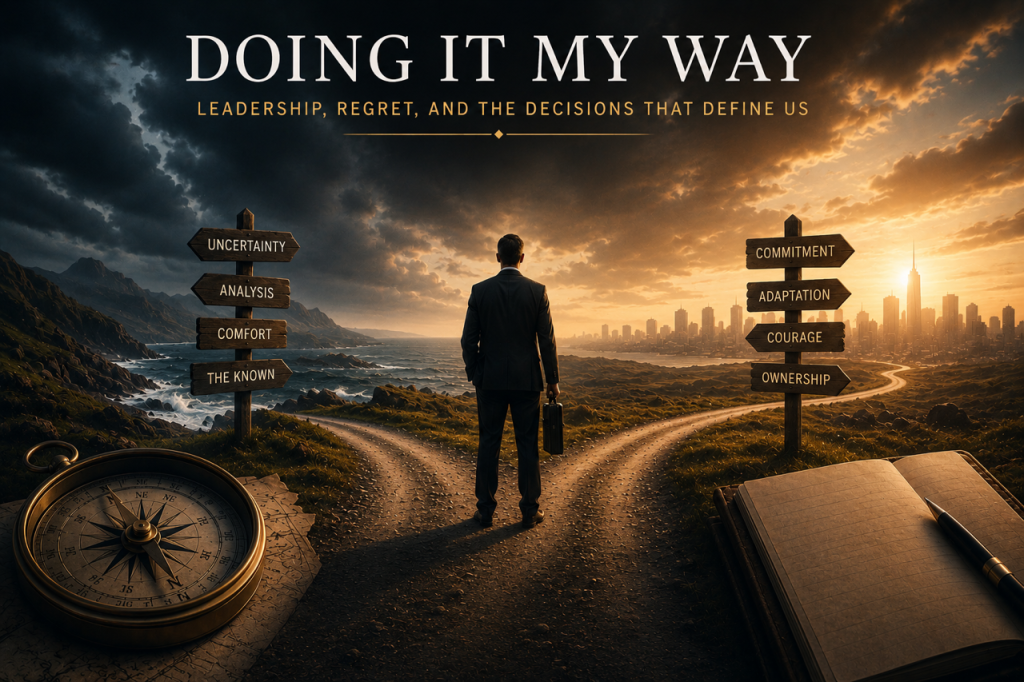
Consider the ancient parable of the traveller at the crossroads. Two paths stretch into the distance. The traveller consults every available map, interrogates every passing stranger, studies the light, and reads the wind. And yet, no amount of analysis eliminates the fundamental condition: one path must be taken, the other abandoned. The maps are helpful, but they are not the territory. The territory reveals itself only in the walking.
This is the condition of modern leadership.
Soren Kierkegaard understood this long before behavioural economists or game theorists attempted to model uncertainty mathematically.
“Marry, and you will regret it. Do not marry, and you will also regret it.” (Kierkegaard, 1843, p. 38)
At first glance, the statement appears cynical. It is not. The observation is not about marriage. It is philosophical: every significant choice closes off alternate futures. And it applies with equal force to any meaningful commitment, professional, personal, or strategic. Kierkegaard chose marriage as his example, but he might just as easily have chosen whether to expand a business, change a career, or commit to a strategy. Every commitment sacrifices alternate possibilities. Every strategic decision creates both gains and losses that cannot be fully known at the moment the choice is made.
Every meaningful choice destroys alternate futures. And the greater the decision, the greater the ghost population of unlived lives that follows behind it.
And yet Kierkegaard’s dilemma contains a trap of its own. The philosopher identifies the inevitability of regret but says nothing about the relative cost of action versus inaction. That asymmetry was captured, rather more bluntly, by a maxim often attributed to the Roman philosopher Cicero: ‘More is lost by indecision than by wrong decision.’ Whether it comes from Cicero or not, the insight holds as a general principle rather than an absolute law. It does not license recklessness – a wrong decision taken impulsively can be as costly as paralysis. But as a description of how most organisations fail, it is precise. Paralysis is not the absence of a choice. It is a choice, and historically, one of the most expensive ones a leader can make.
For those who prefer a more structured analytical approach to navigating that dilemma, decision tree analysis offers a useful complement to regret minimisation. By mapping probable outcomes, assigning probabilities, and calculating expected values across alternative paths, decision trees make the cost of indecision visible in quantitative terms. They do not eliminate uncertainty – but they force the leader to confront it explicitly rather than avoid it. The limitation, as with all models, is that the tree can only represent outcomes the analyst has imagined. The territory, as always, reserves the right to produce outcomes that were never on the diagram.
Executives often assume that enough analysis will eventually reveal the correct answer. Entire corporate cultures are built around the fantasy that uncertainty can be eliminated through dashboards, forecasting models, consultants, AI systems, or strategic planning frameworks. But in highly interconnected environments, the future cannot be solved like an accounting equation. Competitors react. Consumers adapt. Governments intervene. Technology evolves. Employees reinterpret incentives. Markets shift psychologically rather than rationally.
The system responds to the decision itself.
Military strategists have always understood this, even when business schools have been slow to teach it. Von Moltke’s observation that no plan survives first contact with the enemy is not a counsel of despair about planning. It is a precise description of how adaptive systems behave. The plan meets the system. The system responds. The plan changes. What remains is not the original strategy but the quality of the leader’s judgement in the moment of contact.
In my previous article, ‘You Never Play Alone: The Illusion of Unilateral Control,’ the central argument was straightforward, if uncomfortable: you are never the only actor in the system. Every decision you make is simultaneously a signal, a provocation, and an invitation for the system to respond. The belief that outcomes can be dictated, rather than negotiated through cascading reactions, is not merely a strategic error. It is a fundamental misreading of how complex systems behave (Nash, 1950).
John Nash fundamentally altered strategic thinking because he recognised that decisions are never made in isolation. In any meaningful system, every participant is simultaneously adjusting to every other participant. Strategy is therefore not about unilateral optimisation. It is about equilibrium within an adaptive environment (Nash, 1950).
Most strategic failures do not arise because leaders lack intelligence. They arise because leaders incorrectly assume static conditions in dynamic systems. A company cuts costs aggressively and destroys morale. A government imposes tariffs and triggers retaliation. A corporation pursues shareholder maximisation and weakens long-term resilience. An executive centralises decision-making and unintentionally slows organisational adaptation.
The problem is rarely the initial decision itself. The problem is the second-order reaction to the decision.
The Cartographer’s Fallacy: Mistaking the Model for the World
There is an old story among military historians about a young officer who, lost in the Alps during an exercise, discovered a map in his breast pocket and used it to navigate his unit to safety. Only on returning to base did he realise the map was of the Pyrenees. He had survived not because the map was accurate, but because having a map at all gave him the confidence to move, observe, and adapt.
The map was wrong. The movement was right.
The corporate world has constructed extraordinarily sophisticated maps: financial models, scenario planners, Monte Carlo simulations, strategic frameworks, and increasingly, artificial intelligence systems capable of processing more data than any human analyst could absorb in a lifetime. These tools have enormous value. But they share one foundational limitation. They show what happens when assumptions hold. They do not show what happens when the territory refuses to resemble the map.
And the territory always, eventually, refuses.
The Austrian economist Friedrich Hayek described this as the ‘knowledge problem’: no planner, executive, government, or strategist can ever possess enough information to fully predict the behaviour of a complex adaptive system (Hayek, 1945). Markets are not equations waiting to be solved. They are living systems in continuous co-evolution. The map is always, in some fundamental sense, behind.
This is not a counsel of despair. It is a counsel of humility. And humility, strategically speaking, is not weakness. It is the foundation of resilience.
The Corporate Record Provides No Shortage of Instructive Evidence.
Xerox’s Palo Alto Research Centre invented the graphical user interface, the computer mouse, and the Ethernet in the 1970s. The company held, quite literally, the map to the digital future. But its leadership, anchored to a model built on photocopier revenue, could not recognise the territory those inventions described. Apple and Microsoft walked onto that terrain without hesitation (Galloway, 2017). Xerox had drawn the map. Others made the journey.
The collapse of the hedge fund Long-Term Capital Management in 1998 reveals the same failure at the highest levels of quantitative sophistication. The fund was led by two Nobel Prise-winning economists and staffed by the most gifted financial mathematicians of their generation. Their models were internally correct, inside the assumptions they were built on. What those models did not account for was the reflexive behaviour of other market participants responding simultaneously to the same signals. When Russia defaulted on its debt, the system did not behave as modelled. It responded as a terrified, interconnected network of actors all attempting to reduce exposure at the same moment (Shiller, 2015). The fund lost over four billion dollars in six weeks. The map was not the territory.
Sears provides perhaps the most instructive case of structural dominance rendered irrelevant by a territory that simply moved on. At its peak, Sears was not merely a retailer. It was the infrastructure of American consumer life, the company that invented the modern catalogue, pioneered the department store, and expanded into insurance, real estate, and financial services. Its map was extraordinarily detailed and comprehensive. And entirely of a world that was quietly ceasing to exist. Amazon did not defeat Sears. Sears defeated itself by assuming that what had made it dominant would continue to make it dominant (Sheffi, 2005). It filed for bankruptcy in 2018.
Kodak is the definitive case. Its engineers invented digital photography in 1975. The company understood the technology. What it failed to model was the speed and completeness with which the market would abandon the territory it had spent a century mapping. Leadership assumed that film’s decline would be gradual enough to manage, that Kodak could control the pace of its own disruption. The territory had no interest in their timeline (Mui, 2012). Kodak filed for bankruptcy in 2012, not from lack of foresight but from overconfidence in its ability to dictate future terms.
The Regret Minimisation Framework: Deciding at the Crossroads
If perfect prediction is impossible, and if even the most sophisticated models will eventually fail to capture the territory, on what basis should consequential decisions be made?
Behavioural economists and decision theorists increasingly converge on a deceptively simple framework: regret minimisation (Loomes and Sugden, 1982). Rather than asking ‘What decision maximises theoretical upside?’, the leader asks ‘What future regret would be hardest to live with?’
Jeff Bezos described leaving a senior position at a Wall Street firm to found Amazon through exactly this lens. He asked himself a single question: at eighty years old, which would he regret more, having tried and failed or never having tried at all? Failure, he concluded, would be survivable. The alternative might not be (Stone, 2013).
Importantly, regret minimisation is not emotional decision-making. It is strategic decision-making under uncertainty. It accepts three realities that most organisations resist psychologically. First: perfect foresight is impossible. The territory will always exceed the map. Second: some level of regret is therefore inevitable; the question is not whether regret will occur, but which regret is more bearable. Third: the objective is not certainty but resilience against irreversible regret, the kind from which recovery is structurally impossible.
This last distinction matters enormously. There is a categorical difference between regret that can be recovered from and regret that cannot. Missing a quarterly target is recoverable. Ceding a decade of technological relevance while protecting short-term margins is structural. The former is a setback. The latter is a Kodak.
Many executives optimise for quarterly comfort rather than long-term strategic resilience. Nokia protected operating stability while smartphone ecosystems evolved. Blockbuster protected late fees while streaming behaviour shifted. Countless organisations delayed AI adaptation because the short-term risks felt more visible than the long-term existential threat. In each case, the fatal error was not poor intelligence. It was asymmetrical regret analysis: the immediate discomfort of change weighted more heavily than the future regret of irrelevance.
The Man Who Played the Game He Was Given
No examination of regret minimisation under conditions of radical uncertainty would be complete without considering the life of Stephen Hawking.
Diagnosed with motor neurone disease at the age of twenty-one, Hawking was given two years to live. The map, by any conventional reading, had run out. The territory ahead appeared to offer nothing but progressive diminishment.
Hawking refused to read the map that way.
He went on to occupy the Lucasian Chair of Mathematics at Cambridge, the same chair once held by Isaac Newton, produced the most widely read work of popular science of the twentieth century, and fundamentally altered humanity’s understanding of black holes, cosmology, and the nature of time. He did so while progressively losing the use of every voluntary muscle in his body, eventually communicating through a single cheek muscle connected to a voice synthesiser (Hawking, 1988).
When asked, near the end of his life, to reflect on what he had made of the conditions he had been given, Hawking, speaking through that synthesiser, offered a response of extraordinary simplicity:
“Who could have wished for more?” (Hawking, as cited in Ferguson, 2011, p. 318)
That question was not rhetorical. It was the most honest account of regret minimisation ever articulated. Hawking did not pretend the conditions were good. He did not deny the magnitude of what had been taken from him. He simply chose, with remarkable consistency across more than five decades, to play the game he had been given with everything he possessed and to find in that playing a life that exceeded, by almost any measure, what most people achieve with far greater resources.
The lesson for leaders is not inspirational in the shallow sense. It is structural. Hawking’s life demonstrates that the framework for navigating irreversible conditions, radical acceptance of what cannot be changed combined with radical commitment to what remains possible, is not merely philosophical. It is the most rational available response to a territory that has departed permanently from the map.
A Personal Reckoning
I have been fortunate to confront this framework not merely in theory, but across nearly five decades of professional life.
In 1986, I made the decision to marry. It is the one decision in my life about which I have no ambiguity whatsoever. Nearly forty years on, that choice has produced a family I could not have imagined: a remarkable wife, two wonderful children, and a grandchild arriving shortly into a world that will need everything we have taught the generations before it. In the words that Hawking used to describe his own life: who could have wished for more?
Ten years into that marriage, I was a successful Chartered Accountant in Mumbai, running a thriving mid-sized firm with a client list that included multinationals and film stars. By any conventional measure, the map looked excellent. The trajectory was clear. The returns were substantial.
And yet the decision I faced was whether to remain in that territory or to abandon it entirely for Australia, a country I believed offered something more important than professional success: a better life for my family.
Most people around me could not understand the choice. From the outside, it looked like surrender, walking away from a position of hard-won strength into radical uncertainty. From the inside, it was a straightforward application of regret minimisation. I asked myself not ‘What is the best outcome I can achieve here?’ but ‘In twenty years, which decision would be harder to live with?’
Now, in my third decade in what I consider the finest country in the world, neither my family nor I carry a single moment of regret about that crossing.
But the most instructive decision of that period was not the migration itself. It happened in the weeks before I left Mumbai, while I was still interviewing candidates for a role in my firm. One of those candidates mentioned, almost in passing, a CMA programme from Australia being conducted for the first time in New Delhi, run by a Professor Janek Ratnatunga.
I confess my first reaction was scepticism. The name suggested a Sri Lankan connection rather than Australian; the programme was unfamiliar, and I was extraordinarily busy, a man with no shortage of demands on his time and no particular appetite for detours. I very nearly dismissed it entirely.
Instead, I researched the Professor. What I discovered stopped me in my tracks. Professor Ratnatunga was not merely credible. He was, by any serious measure, one of the finest management accounting educators in the world, a scholar of genuine distinction whose work had shaped the discipline across multiple continents.
The decision I then faced was not a grand one by outward appearances. Fly to Delhi. Book a hotel room for ten days. The financial cost was modest. But the real cost was time, and time, for someone in my position, was the scarcest resource I possessed.
Was it worth it? I decided, with no certainty whatsoever, that perhaps it was.
The answer, perhaps, turned out to be one of the most consequential of my professional life. What I learned in that programme over those ten days became the single greatest intellectual contributor to the success I went on to build in Australia. It did not merely add to my professional toolkit. It reframed the way I understood organisations, strategy, and the relationship between financial intelligence and genuine leadership.
It is also, in the most direct sense, the reason I am writing this article. That experience planted in me a passion for passing knowledge forward, a conviction that the most valuable thing a leader can do, having navigated uncertainty and emerged with hard-won understanding, is to ensure that the next generation does not have to navigate it entirely alone.
The final decision in this series came almost ten years ago, when I chose to step away from corporate life and take on the role of a C-suite management educator at CMA Australia. From the outside, again, it appeared to be a retreat from the summit. From the inside, it was a recognition that the territory I most wanted to explore was not behind me but ahead; and that the knowledge I had spent five decades building, rather than being kept to myself, was most valuable if passed on to those still finding their way.
Looking back, it was the best professional decision I have ever made. Not because it was the safest, but because it was the most honest about my values and the most committed to a future I could not yet fully see.
Across nearly five decades of decisions, I have not always been right. But I have tried, consistently, to ask the right question. Not ‘What is the optimal outcome?’ but ‘Which regret could I not carry?’
That question has never failed me and ‘more, much more than this, I did it my way.’
The Parable of the Burning Platform
In 1988, an explosion on the Piper Alpha oil platform in the North Sea killed 167 workers. One survivor, Andy Mochan, later described his decision to jump sixty feet into burning, debris-filled water below. Under normal conditions, the jump was almost certainly fatal. But remaining on the platform was certainly fatal. So, he jumped (Flin, 1996).
The burning platform has since become a cliche in leadership literature. But the deeper insight is usually missed. Mochan did not jump because he possessed certainty. He jumped because he understood which regret was unacceptable. This is the structure of every meaningful strategic decision made under genuine uncertainty. The map does not tell you what to do. The framework for evaluating regret does.
Doing it My Way: The Philosophy of Committed Action
When Sinatra first sang ‘My Way’ in 1969, he had already lived through failure, reinvention, professional exile, and return. That biography matters. Because the song’s philosophical weight does not rest on the claim that every decision was correct. It rests on something more important: that every decision was made with full commitment to the reality of the moment. ‘ I planned each charted course, each careful step along the byway. This is not a perfect course; it is a planned one. The distinction is everything. The song does not claim the map was right. It claims the journey was taken seriously. This is the resolution that all the strategic frameworks in this article – regret minimisation, adaptive systems, Nash equilibria, the knowledge problem – are ultimately pointing towards. The analytical machinery exists to help leaders see the situation clearly. But seeing it clearly is only the precondition. The act that determines everything is the commitment to engage fully, without the paralysis of wishing for different conditions.
This is not a counsel of resignation. It is a counsel of clarity. The circumstances you inherit are simply the starting condition. What matters is not the position you begin from but the quality of commitment brought to playing the game from that position. The great strategic error is not uncertainty. It is the refusal to accept the territory as it actually exists – spending strategic energy mourning a reality that does not exist instead of acting decisively within the one that does.
The cases examined earlier – Kodak, Sears, Long-Term Capital Management – are all, at their root, the same story: organisations that exhausted their energy defending a territory that had already ceased to exist rather than committing to the one that had taken its place.
Stephen Hawking was given conditions that most people would have surrendered to entirely. He played the game with such completeness that the rest of us are still learning from what he achieved. Sinatra’s ‘My Way’ and Hawking’s ‘Who could have wished for more?’, are, at their core, the same statement. Not that the conditions were good. That the commitment was total.
The executives who navigate uncertainty most effectively are not those who begin from better positions. They are those who develop the discipline, the honesty, and the character to engage fully with the situation in front of them — completely, strategically, and without looking back at the ships they burned to get here.
The Disciplines of Dynamic Decision-Making
Translating this commitment into practice requires abandoning the static logic of most planning cycles. Four habits of mind distinguish the leaders who navigate uncertainty from those who are defeated by it.
The first is learning to distinguish reversible from irreversible decisions, and treating them with entirely different levels of deliberation. Many organisations apply excessive bureaucracy to decisions that are easily undone, while making irreversible decisions emotionally, politically, or by default. Amazon institutionalised this distinction through what it calls Type 1 and Type 2 decisions: one-way doors and two-way doors (Bezos, 2016). Entering a new market, acquiring a company, restructuring an organisation – these are one-way doors. They warrant deep analysis and deliberate movement. A pricing experiment, a product feature, a communications approach – these can be reversed quickly if they fail. They warrant speed. Organisations that conflate the two become simultaneously paralysed where agility is required and reckless where care is essential.
The second is optimising for optionality rather than prediction accuracy. In volatile environments, the organisation that survives is rarely the one that predicted most accurately. It is the one that preserved the greatest capacity to adapt when the territory shifted. Cash reserves, diversified supply chains, modular technology architectures, and decentralised information flows are not inefficiencies to be engineered out. They are strategic options kept open (Taleb, 2012). The corporate obsession with just-in-time efficiency that dominated three decades of management thinking produced organisations of extraordinary precision and extraordinary fragility. When the COVID-19 pandemic fractured global supply chains, companies discovered that they had optimised for a territory that no longer existed (Sheffi, 2005).
The third is accounting for reflexivity, the recognition that the system observes the player. Markets do not merely respond to fundamentals. They respond to beliefs about fundamentals. Employees do not simply react to policy. They react to perceived intent, fairness, and what they believe the policy signals about the future. Competitors respond strategically to your own strategic signals (Soros, 1987). A cost-reduction programme that is financially rational in isolation may destroy the organisational culture that made performance possible. The map shows the move. It does not show the cascade of reactions that follow.
The fourth, and perhaps the most counterintuitive, is developing a deep suspicion of excessive certainty. Behavioural research on the illusion of control demonstrates that individuals systematically overestimate their ability to influence outcomes in complex environments and that this overestimation intensifies under conditions of power, familiarity, and prior success (Langer, 1975; Kahneman, 2011). The leaders most in danger are rarely the uncertain ones. They are the ones who have stopped asking whether the map still matches the territory, because the last several maps were close enough. Nokia held over 40 per cent of the global mobile handset market in the mid-2000s. That dominance did not produce caution. It produced the assumption that dominance was self-perpetuating, an assumption that Apple and Google dismantled by changing the game entirely (Doz and Wilson, 2018). The certainty was the warning sign that went unread.
The Productive Regret: On the Necessity of Meaningful Failure
There is a final dimension to this argument that many leadership frameworks avoid because it is genuinely uncomfortable.
Not all regret is pathological. Some regret is evidence of meaningful choice. A company that innovates will sometimes fail. A leader who acts decisively will occasionally be wrong. A board that takes strategic risk will endure criticism. An organisation that transforms itself will create disruption and discomfort.
The absence of regret is not evidence of wisdom. Sometimes it is evidence that nothing meaningful was attempted.
The Japanese philosophy of wabi-sabi holds that imperfection and transience are not flaws to be corrected but part of the texture of authentic existence (Koren, 1994). A cracked tea bowl is not inferior because it bears scars. It is more honest. It is evidence of a life used rather than merely preserved.
The strategic equivalent is this: an organisation without the scars of meaningful risk is often an organisation managed merely for survival rather than built for significance. The leaders who are most remembered did not avoid regret. They chose their regrets carefully and had the character to carry them.
Conclusion: The Territory Always Exceeds the Map
“No plan survives first contact with the enemy.” Helmuth von Moltke the Elder (1880, as cited in Hughes, 1993, p. 92)
The central insight linking Darwin, Kierkegaard, Nash, Hayek, Hawking, and Sinatra — and the organisations and lives examined throughout this article — is this: uncertainty is not a temporary condition awaiting resolution. It is the permanent operating environment of meaningful action.
Darwin’s observation was not merely biological. It was strategic. Survival belongs not to the strongest or most intelligent, but to those most responsive to change. And responsiveness, real responsiveness, not the performative agility of the corporate planning cycle, begins with accepting that the territory will always exceed the map.
You cannot build a map that equals the territory. You cannot model a system that will not respond to your modelling. You cannot eliminate regret from a life, or an organisation, genuinely committed to something.
What you can do is choose your framework for navigating the crossroads. You can ask not merely ‘What is the best outcome?’ but ‘What happens when the system responds, and which response would be hardest to recover from?’ You can distinguish the regrets worth risking from the regrets worth fearing. You can build not for the territory on the map but for the capacity to adapt when the map inevitably runs out.
The great strategic error is not uncertainty. It is the refusal to accept the territory as it actually exists. Entire corporations, careers, and lives are diminished not because the starting conditions were poor, but because energy was spent mourning the conditions that might have existed instead. The leaders who endure are rarely those granted perfect circumstances. They are those capable of committing fully, and without reservation, to imperfect realities, before the map confirms the path.
Commit to the game you are in. Play it with everything you have. Do it your way. Because the ships are already burning — and the only direction that has ever mattered is forward.
Dr Chris D’Souza is Deputy CEO of CMA Australia.
References
Bezos, J. (2016) 2015 Letter to Shareholders. Amazon.com, Inc.
Darwin, C. (1859) On the Origin of Species by Means of Natural Selection. John Murray.
Anka, P. (1969) ‘My Way’ [Song recorded by F. Sinatra]. Reprise Records].
Doz, Y. and Wilson, K. (2018) Ringtone: Exploring the Rise and Fall of Nokia in Mobile Phones. Oxford University Press.
D’Souza, C. (2025) ‘You Never Play Alone: The Illusion of Unilateral Control’, On Target, CMA Australia & New Zealand. Available at: https://ontarget.cmaaustralia.edu.au
Ferguson, K. (2011) Stephen Hawking: An Unfettered Mind. Palgrave Macmillan.
Flin, R. (1996) Sitting in the Hot Seat: Leaders and Teams for Critical Incident Management. John Wiley & Sons.
Galloway, S. (2017) The Four: The Hidden DNA of Amazon, Apple, Facebook and Google. Portfolio/Penguin.
Hayek, F. A. (1945) ‘The Use of Knowledge in Society’, American Economic Review, 35(4), pp. 519-530.
Hawking, S. W. (1988) A Brief History of Time: From the Big Bang to Black Holes. Bantam Press.
Hughes, D. J. (ed.) (1993) Moltke on the Art of War: Selected Writings. Presidio Press.
Kahneman, D. (2011) Thinking, Fast and Slow. Farrar, Straus and Giroux.
Kierkegaard, S. (1843) Either/Or: A Fragment of Life. Translated by H. V. Hong and E. H. Hong (1987). Princeton University Press.
Koren, L. (1994) Wabi-Sabi for Artists, Designers, Poets and Philosophers. Stone Bridge Press.
Langer, E. J. (1975) ‘The Illusion of Control’, Journal of Personality and Social Psychology, 32(2), pp. 311-328.
Loomes, G. and Sugden, R. (1982) ‘Regret Theory: An Alternative Theory of Rational Choice Under Uncertainty’, Economic Journal, 92(368), pp. 805-824.
Megginson, L. C. (1963) ‘Lessons from Europe for American Business’, Southwestern Social Science Quarterly, 44(1), pp. 3-13.
Mui, C. (2012) ‘How Kodak Failed’, Forbes, 18 January. Available at: https://www.forbes.com
Nash, J. F. (1950) ‘Equilibrium Points in n-Person Games’, Proceedings of the National Academy of Sciences, 36(1), pp. 48-49.
Ratnatunga, J. (2000) Strategic Management Accounting. Institute of Certified Management Accountants.
Sheffi, Y. (2005) The Resilient Enterprise: Overcoming Vulnerability for Competitive Advantage. MIT Press.
Shiller, R. J. (2015) Irrational Exuberance. 3rd edn. Princeton University Press.
Soros, G. (1987) The Alchemy of Finance: Reading the Mind of the Market. Simon and Schuster.
Stone, B. (2013) The Everything Store: Jeff Bezos and the Age of Amazon. Little, Brown and Company.
Taleb, N. N. (2012) Antifragile: Things That Gain from Disorder. Random House.