

President Donald Trump has just appointed a new chairman of the Federal Reserve, America’s equivalent of a Central Bank. He is Dr Kevin Warsh, who was sworn in on May 22, 2026, succeeding Dr Jerome Powell, who had led the US central bank since 2018. President Trump hopes that Dr Warsh will reduce interest rates and stimulate the economy.
But can he?
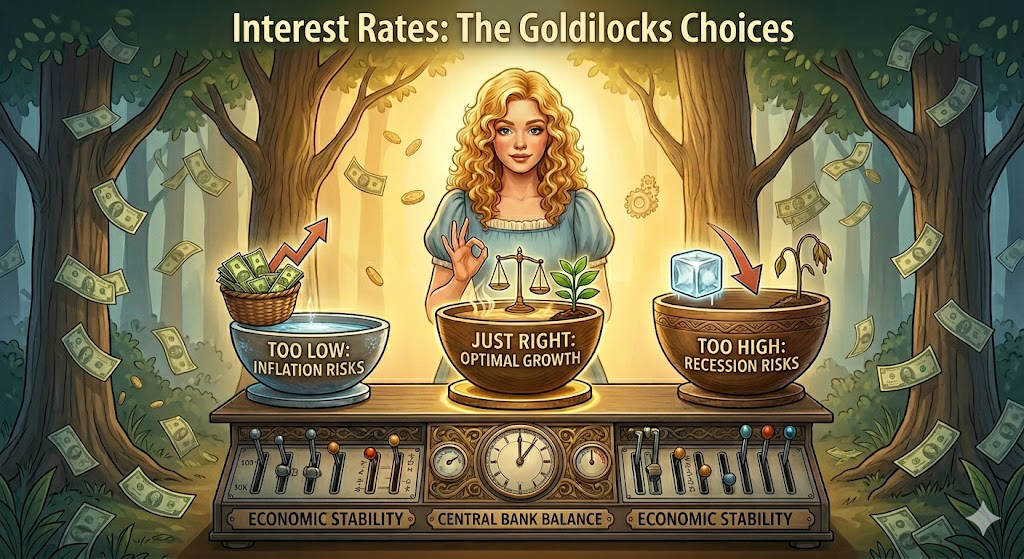
Goldilocks had a choice of three bowls of porridge and, finding the first was “too hot” and the second “too cold”, found the third to be “just right”. Unfortunately, none of the three bowls in front of Dr Warsh leads to a ‘just right’ outcome.
Consuming the first bowl will result in a ‘crashed economy’. Consuming the second makes the US dollar a ‘dying currency’. Consuming the third is the ‘end of American credibility’. There appears to be no fourth ‘just right’ bowl.
Let me explain.
But first a history lesson.
The Foundation of the Federal Reserve
On the morning of October 22nd, 1907, a line of frightened New Yorkers stretched around the block at the corner of Fifth Avenue and 34th Street. They were holding bank books. They were waiting to pull their savings out of an institution called the Knickerbocker Trust Company, the third largest Trust company in New York, where they had collectively deposited what would today be the equivalent of about half a billion dollars. But by 12:30 in the afternoon, the Trust had paid out all its cash, about $8 million, and locked its doors. The president of the Knickerbocker, a man named Mr Charles Barney, walked home, and three weeks later, he shot himself (Fresno Bee, 1907).
Now, from the Knickerbocker, the panic spread. Other Trusts faced runs. The New York Stock Exchange nearly closed because banks ran out of cash to fund routine margin trades. However, at the time, there was no entity in the entire United States whose job it was to step in and stop the financial system from collapsing on itself.
It was left to one man to do it – John Pierpont Morgan, better known as JP Morgan. He was 70 years old, semi-retired, and one of the wealthiest men alive at the time. For the next two weeks, he ran the rescue of the United States financial system out of his personal library on Madison Avenue. He gathered the heads of all the major New York Banks and Trusts into his home and told them they were not leaving until they had pulled enough cash to reinforce the system. He personally examined the books of the troubled Trusts and decided which ones were solvent enough to save and which had to be allowed to fail. He coordinated about $25 million in emergency loans, a staggering sum at the time. He sorted the wreckage in front of him into two piles. The institutions he could save and those he could not save. The latter he let die. And it worked. The panic was contained, and the financial system survived.
But take a step back and look at what had happened. One elderly private banker, prioritising institutions from his own library, had saved the American economy from collapse. Morgan held no charter, no mandate, and no government authority. But he did have cash, credibility, and the willingness to use them. If he had been travelling in Europe at that time, or if he had been sick, dead, or simply uninterested, the United States might have crashed in a way no one in this century has ever seen.
The obvious conclusion from what happened in 1907 was that America could not keep relying on one rich man to save it. And so, three years later, in late 1910, a small group of men travelled to a hunting club owned by JP Morgan himself, with the purpose of drafting in secret what would become the Federal Reserve Act. [Note that other countries have the word ‘Reserve’ to describe their Central Bank, e.g., Australia has the Reserve Bank of Australia, but only the USA refers to its Central Bank as the ‘Fed’.]
Three years after that secret meeting, President Woodrow Wilson signed the Federal Reserve Act into law on December 23, 1913, and created a new institution, the Federal Reserve (or Fed), that had the power to do on demand what JP Morgan had done in 1907 using the wealth of private individuals. When banks ran short of cash, the Fed could create new cash and lend it to them. When markets froze, the Fed could thaw them out. When the system needed liquidity – where an asset can be bought or sold without causing a drastic change in its price – the Fed could produce the required number of active buyers and sellers.
And that is the founding mission of the Federal Reserve. It exists to prevent another Knickerbocker crash and to make choices to guide the financial system in the moments when nobody else can. For over a century, it has done its job well. America has not had another 1907 panic, and every panic since 1987, 1998, 2008, and 2020 has received the same medicine:
The Fed steps in, creates dollars, and buys what no one else will buy. The economy stabilises.
How the Federal Reserve Works Today
JP Morgan saved the financial system in 1907 by using the wealth that he and his peers had already earned, i.e., cash, gold, and deposits. He moved real money around. He did not invent any.
The Fed does not work that way anymore. When it steps in to save the system, it does so by creating new dollars out of thin air, not figuratively but literally. The Fed types those dollars into the accounts of commercial banks that did not have the money five seconds earlier, and the new dollars enter circulation. This is called ‘quantitative easing’ and, more colloquially, ‘money printing’. However, this is not a printing press – it is a computer keyboard. There is no vault of gold to back the new dollars. There is only the promise that they will hold their value, i.e., what is called a ‘fiat currency’ (see Ratnatunga, 2021).
Every panic the Fed has prevented since 1913 has added to the pile of these ‘keyboard-created dollars’. Every recession, every banking crisis, every wobble in the bond market – every one of these crises has been met with another round of US dollar creation. This dollar pile has grown for over a hundred years, and, since President Nixon took the US dollar off the gold standard in 1971, all these new US dollars created out of thin air have been backed by trust rather than gold. [It is also backed by oil and known as the ‘petrodollar’ (see Ratnatunga, 2026)].
There is now an unimaginably tall pile of ‘created US dollars’ resting on an unspoken agreement that everyone will continue to accept it as wealth. However, in May 2026, this tower of US dollar debt has started to lean visibly, with the US public debt of $37.64 trillion officially exceeding its Gross Domestic Product (or GDP) of $31.22 trillion (Goodell-Ugalde and Braun, 2026).
The distinction between JP Morgan moving around existing money (backed by gold) and the Fed creating new money (backed by faith) is a Goldilocks policy choice faced by Dr Warsh, the newly appointed head of the Federal Reserve, and by extension, every other Central banker in the world.
The Impact of the Visible and Invisible Wars
In the Visible war, the Strait of Hormuz is still closed in early June 2026, with about 20% of the world’s oil being off the market for the last 60 days. Oil is over $100 per barrel and rising. The inflation that everybody in the USA claimed had been beaten last year is accelerating again.
The latest published data for the Core Personal Consumption Expenditures Price Index was the worst since 2022. This Core PCE print refers to the Federal Reserve’s primary measure for tracking U.S. inflation, capturing the average changes in prices of goods and services consumed by individuals while stripping out volatile food and energy costs (BEA, 2026). The data has not, however, yet fully priced in the impact of the last 3 months of expensive oil.
The invisible war is a consequence of the visible war.
The United States funds itself with debt, and like a consumer living on a credit card, it must access more debt. This debt is provided by Foreign governments that hold about $9.4 trillion of US Treasury bonds. When the war broke out and oil prices surged, some of those governments were forced to sell their US Treasury Bonds to raise the money they needed at home to buy oil on the open market.
Now, when too many holders sell, the price of those bonds falls. This is the same as for any asset. If there are more sellers than buyers, the price will fall. And when the price of a US Treasury bond falls, the interest rate the United States must pay on new debt climbs. This phenomenon is because a bond pays a fixed amount of cash, and therefore a bond’s price and its yield (the interest rate it pays) have an inverse relationship. If the price goes down, the fixed payout represents a higher overall percentage return for anyone buying it at that new, lower price. As such, at too high of an interest rate, the interest bill on America’s $37 trillion of debt starts to compound on itself faster than the US federal budget can absorb.
A case in point was when the United Arab Emirates (UAE), which is heavily dependent on selling oil through the Strait of Hormuz, saw its cash flow shut off for over the first 12 weeks of the war. Now, the UAE holds about $95.6 billion in US Treasury bonds alone, plus trillions more in its sovereign wealth funds. If the UAE had sold those treasuries to raise cash, it would have collapsed the bond market. So, instead, what the UAE did was to approach Washington with a proposal. They said, “Help us or we will have no option but to sell your bonds, which will ultimately crash your bond market.” They asked for an emergency short-term loan known as a currency swap line.
This raises an important question. How does the US, whose own government runs entirely on borrowed money and requires other countries to lend it dollars to fund its operations, suddenly turn around and lend another country tens of billions of those same dollars on demand?
The answer is computer keystrokes.
When the Fed extends a currency swap line, the dollars on the US side of the trade are not pulled from a vault. They are not taken from US taxpayers. They are simply typed into existence on a computer keyboard at the Federal Reserve in Washington. One moment they do not exist; the next moment they sit in an account at the Central Bank of the UAE (or any other foreign country wanting US dollars). There is no printing press, no physical paper, just simple keystrokes. And that is how every currency swap line in modern history has been funded. The Fed conjures the dollars on demand, lends them out, and the leaning tower of all the US dollars ever created grows by exactly that much.
If the borrower pays those dollars back at maturity, the loan comes off the Fed’s books, and the dollars that were typed into existence vanish from the system. So, there is no net growth in the money supply. The cycle closes cleanly. And to date, it is important to know that every currency swap line the Fed has ever extended has been paid back.
Qualified Borrowers
However, one cannot take solace in the fact that all currency swaps done by the Fed to date have been paid back, because this perfect history has been built on a very specific group of borrowers. Until recently, the Fed’s currency swap line network was restricted to a small list of qualified economies: The European Central Bank, the Bank of Japan, the Bank of England, the Bank of Canada, and the Swiss National Bank. These are all large, mature, stable institutions backed by countries that actually earn the dollars through robust economies.
During the Global Financial Crisis (GFC) and the Covid-19 Pandemic, the Fed extended temporary emergency swap lines to Australia, Brazil, Denmark, Mexico, New Zealand, Norway, Singapore, South Korea, and Sweden. Central banks in these countries drew down these facilities to inject dollar liquidity into their domestic systems and repaid them later in full.
But last year, that wall came down. Argentina, a country with one of the most volatile currencies on the planet and with nine sovereign defaults in 200 years of history, was added to that list. Further, on April 22, 2026, in a testimony before the US Senators on Capitol Hill, US Treasury Secretary Scott Bessent confirmed that many Gulf and Asian allies had requested currency swap lines of their own. He defended the practice as protecting dollar liquidity in stress scenarios (Chiacu and Jones, 2026). The longer the list of countries borrowing emergency dollars, the higher the probability that the terms on those loans will get adjusted to meet the borrower’s repayment capacity.
In banking, this practice is called ‘amend, extend, and pretend’.
Banks amend the terms of the loan to extend the maturity date and pretend everything will be fine. Loans get extended. New ones replaced. Maturity dates slide further into the future. The created dollars stop vanishing. They start accumulating.
Goldilocks’ or Hobson’s Choice?
The man who has inherited this mess, and the tools to deal with it, is about to make a choice. And when faced with this choice, almost every Fed chairman has made the same call.
They have printed more money.
Dr. Kevin Warsh, the new Fed chairman, has inherited the most consequential job in global finance at the worst possible moment to do so. We will argue that he is left not with a Goldilocks’ choice, but instead a Hobson’s choice, i.e., a choice that appears to be made ‘freely’ but in reality is ‘unfree’. It describes a situation where one seems to have a choice, but in reality, only one option is available.
The phrase essentially means “take it or leave it”, where leaving it is usually an undesirable outcome.
Goldilocks’ Choices
Like Goldilocks, Dr Warsh has three choices. All three will cost the United States something that it cannot really afford to lose. Let us run through all three.
Choice one: “Save the dollar”. Stop creating new dollars and raise interest rates. Defend the value of the currency. Now, higher interest rates make US debt more attractive to foreign buyers. When foreigners come back to the auctions, the Fed does not have to step in and create new dollars to absorb the bonds that nobody else wants because higher interest rates incentivise other foreigners to buy that debt. So fewer dollars mean less inflation, and less inflation means the currency holds its value. A currency’s value, like the value of anything else, is set by supply and demand. So scarce, expensive money holds its value better than abundant, cheap money. And this strategy is the textbook play for any Central Bank facing a weakening currency and rising inflation. But it crushes the economy as a result.
This is exactly the playbook that Fed Chairman Paul Volker ran in 1980. When Dr Volker walked into the Federal Reserve building in August of 1979, there were a few things going on. American inflation had risen above 11%, and it was climbing. The US dollar had been losing value for a decade. Washington had been printing money to pay for the Vietnam war, and its ‘Great Society programs’. The Middle East had delivered two oil shocks in the last 6 years. Americans were starting to lose confidence in their currency. [Does this not sound remarkably familiar with the situation today?].
Dr Volker decided that the only way out was to defend the dollar and break inflation. So, he raised the federal interest rates to 20%. And it worked. He crushed inflation. The dollar strengthened against every major currency on Earth. But the cost was brutal. The United States experienced two back-to-back recessions. Unemployment hit nearly 11%. Farms went bankrupt by the thousands. Construction workers were laid off in massive numbers in every State.
Hard as it was, the American economy could afford the cost in the 1980s because its federal debt was only 30% of GDP. Today it is approximately $37.64 trillion, which represents a Debt-to-GDP ratio of 124%. The annual interest bill on existing US debt is already over a trillion. If Dr Warsh raised interest rates today the way Dr Voker did in 1980, the interest bill would not just double. It would quadruple. Further, in 2026, the American public is far more sensitive to interest rate hikes than it was in 1980. Today, housing in the USA is leveraged, commercial real estate is leveraged, private equity is leveraged, and corporate America has trillions of dollars in debt coming due in the next three years that will have to be refinanced at whatever rate Dr Warsh and the Fed settle on.
Therefore, choice number one, saving the dollar by making rates high and dollars scarce, triggers a fast death of the American economy. Such a move will be political suicide for both Dr Warsh and the person who appointed him, President Donald Trump.
Choice two: “Save the bond market”. This is effectively the opposite of choice number one. In this scenario, Dr Warsh would create enough new dollars to absorb the bonds that nobody else wants. Keep funding the American government by creating (printing) money to keep the economy running. This is the playbook the Fed has been running, especially since the global financial crisis of 2008. It is the playbook behind every round of quantitative easing. It is the playbook behind every swap line, every emergency facility, and every dollar typed into a bank’s reserve account to soak up treasury bonds that no foreign creditor will buy at today’s prices.
And it has worked up to now. Rates do not have to climb to the true market value because the US prints money and buys its own surplus debt. As a result, the interest bill stays manageable. The lights therefore stay on. However, every dollar created this way is one more layer on that leaning tower. As the supply of dollars gradually goes up, the value of each dollar gradually goes down. At the supermarket, at the petrol pump, in the mortgage payment, and in the price of a child’s school year – each round of printing pushes another layer of inflation through the American economy. Wages do not keep up. Savings shrink relative to what they can buy. Fixed-income retirees watch their purchasing power evaporate. The Americans who already own real assets – shares, homes, real estate, gold – get richer in nominal terms. However, the Americans who do not, get poorer in real terms.
So, choice two saves the bond market by killing the currency. If choice one is a fast death, choice two is a slow death, a problem for another day, a problem that can be disguised as something else.
This second choice is always a politician’s preferred choice. Because most people do not understand how inflation actually works, they do not know who to blame for it. They can feel the price of groceries climbing. They can feel the rent going up. They feel their take-home pay shrinking in what it can buy, but they cannot trace the cause back to a decision made at their central bank months or years earlier. They blame corporate greed. They blame foreign countries. They blame immigration. They blame the previous administration. But conspicuously, the central bank is almost never on the bad guy list.
Choice Three: “Release the Pressure”. This choice is a bit of an outlier because it is actually outside of the Fed’s control but still would have a dramatic impact on the decisions that Dr Warsh will have to make. In choice three, the dark horse, the United States ends the war with Iran. They walk away. They let Hormuz reopen under Iranian control. They let the oil price come down. They let the pressure on the system release. If oil drops back to $60, inflation will eventually cool on its own, and the Treasury auctions might normalise.
But the price of the third choice is not paid by the Fed. It is paid in terms of American credibility. If the Americans were to withdraw on Iran’s terms, although there would be a marketing spin back in the White House to convince the American people that somehow this is “mission accomplished”, the rest of the world would see what really happened; i.e., that the United States started a war and then was forced to retreat. And every adversary the United States has – Beijing watching Taiwan, Moscow watching NATO, and every smaller power watching whether American security commitments are worth the paper they are printed on – updates their estimate of what Washington can actually accomplish in terms of their security.
It must be remembered that the dollar’s premium as the world’s reserve currency rests in the end on a single belief that the United States can project force globally and back its security commitments. If you take that belief away, foreign powers are going to hold fewer dollars, want fewer treasury bonds, and demand higher returns for the dollars that they still buy. Choice three saves the dollar in the technical sense but destroys the foundation that it stands on.
Are There Any Other Choices?
One may think that there are more than three choices in a central banker’s playbook. What about raising taxes? Defaulting on the loans? Restructuring the debt? Recalculating the inflation statistics? After all, Dr Warsh wants to change how the Fed calculates and measures inflation and wants to use trimmed mean metrics. Rather than focusing purely on core indices, he wants to strip out extreme price changes across all spending categories to find the “underlying” inflation rate (Harring, 2026). He is of the view that by ignoring anomalies policymakers can isolate persistent, foundational price trends and adjust interest rates accordingly (Economist, 2026).
However, if you look closely, every alternative is just a subvariant of one of the three Goldilocks choices: (1) increase interest rates and destroy the economy; (2) create dollars out of thin air and destroy the currency; or (3) remove the pressure that is causing a run on the dollar and destroy American credibility as a superpower. Choice one is a fast death – it breaks the bond market and the economy in weeks. Choices two and three are slow deaths that weaken the dollar over years.
There is no fourth choice.
The International Scene
The decisions made by the Federal Reserve Chairman significantly impact global economies due to the sheer size and influence of the US economy, which is the largest in the world. When the Fed adjusts interest rates, it affects global financial markets, as investors may shift their capital based on anticipated returns, influencing exchange rates and investment flows worldwide. For example, an increase in US interest rates can attract foreign investments. This will lead to more US dollars being demanded causing the US dollar to appreciate. This will result in it being more expensive for other countries to service US dollar-denominated debts. This can lead to increased borrowing costs and financial strain, especially in emerging markets. Additionally, changes in US monetary policy can impact global trade by affecting consumer spending and demand for imports, thereby influencing economic growth rates globally.
Thus, the interconnected nature of today’s global economy means that the Fed’s monetary policies can set trends that other central banks may be forced to follow, further amplifying their ripple effects across borders. However, the impacts are also contextual, often based on both economic and political factors. For example, while Australian mortgage holders are grappling with rising repayments, some countries have not seen interest rate rises in years. The United Kingdom and New Zealand have not increased rates since 2023, while Japan has had decades of low, and in some cases negative, interest rates.
Here is a summary of what is happening with interest rates in some major economies, the economic conditions influencing them, and what the future might hold for mortgage holders in those countries.
Australia
The Reserve Bank raised Australia’s cash rate by 25 basis points to 4.35 per cent on May 5, 2026, citing concerns about inflation amid the war in the Middle East. While it might appear that borrowers have it easier in other countries, it is not that simple. It appears that some of Australia’s closest neighbours and partners are making interest rate choices based on higher unemployment, weak currencies, or after lowering rates less aggressively in the past.
The fact that interest rates are high in Australia most likely reflects the fact that its economy is actually performing better than other countries. The view is that the Central bank in Australia is responding by lifting interest rates because they are seeing less slack in the Australian economy and, with it, upward inflation pressures (Martin et al., 2026).
New Zealand
New Zealand’s official interest rate is 2.25 per cent on November 26, 2025, following the central bank lowering it steadily from a post-COVID peak of 5.5 per cent. But compared to Australia, New Zealand’s unemployment rate is higher and its economic growth weaker, a major reason for the record number of New Zealanders moving to Australia for work (Angeloni and Marchese, 2025).
New Zealand’s low interest rate whilst stimulating the economy, is contributing to inflation. Its central bank is also monitoring how the high cost of fuel due to the effective closure of the Strait of Hormuz will affect prices and wages across New Zealand. Inflation is expected to rise to more than 4 per cent for the June 2026 quarter on the back of surging fuel prices. Due to all these factors, the informed view is that New Zealand’s central bank appears poised to raise the cash rate (Martin, et.al., 2026).
United Kingdom
The UK is also feeling the effects of the energy crisis, but the Bank of England (BoE) chose to maintain the interest rate at 3.75 per cent in April, the lowest point since it peaked at a 16-year high of 5.25 per cent in 2023. Interest rates had been tipped to keep falling in the UK in 2026 because there were signs suggesting that inflation was decreasing.
However, due to the global impact of the conflict in the Middle East, inflation has risen to 3.3 percent (compared to the UK government’s target of 2 percent) and is tipped to keep rising as higher energy prices continue to hit (Knowles, 2026).
As such, there was an expectation that the UK had to brace for higher interest rates in June 2026. However, on 30 May 2026, in a signal that borrowing costs will remain at 3.75% – at least during its summer – the governor of the BoE said that it is in no rush to raise interest rates while the outcome of the Iran war remains uncertain and the UK’s growth rate stays weak. He said it was tolerable for inflation to stay above the bank’s 2% target during the current crisis, but that would change if a more permanent increase in prices began to take effect (Inman, 2026).
Japan
Japan’s central bank started raising interest rates in 2024, even as other countries were cutting theirs. But the rate has risen from a much lower base compared to Australia, reaching 0.75 percent when the Bank of Japan (BoJ) last increased the interest rate to a three-decade high in December 2025.
The central bank has kept interest rates low ever since Japan’s “lost decade”: a period of economic stagnation in the 1990s, starting when its asset bubble burst due to over-investment in land and stocks. More recently, it used low or negative interest rates to combat weaker consumer spending and labour shortages stemming from an aging Japanese population.
Since the outbreak of the Middle East war, while the BoJ has paused rate hikes, a split has emerged over whether to raise interest rates at its most recent board meeting in May 2026. Some members said the BoJ should monitor the conflict’s potential damage to the economy, while others warned of mounting price pressures (Kihara, 2026). The view is that if the BoJ chooses to keep the interest rate low or unchanged, then the Japanese yen will depreciate even more, and that will create further pressure on the inflation.
Indonesia
The Bank Indonesia (BI) is trying to support economic growth while also protecting the nation’s currency from dropping in value. As such, Bank Indonesia was doing a balancing act by trying to hold interest rates at 4.75 percent to help drive the domestic economy amid highly uncertain global economic volatility. The Bank realised that if the interest rate rose too high, banks were likely to increase deposit and lending rates, making credit more expensive for households and businesses, potentially slowing economic activity.
BI also had limited room to cut rates further because the Indonesian Rupiah exchange rate has been very volatile and has even experienced significant depreciation over the last 3 months since the Middle East conflict started. As such, it was expected that BI might have to raise rates if pressure on the rupiah intensified.
Therefore, BI’s decision to aggressively hike the BI rate by 50 bps to 5.25% in May 2026, whilst not unexpected, was still surprising, as it was double the expected 25 bps. This pre-emptive tightening aims to defend the currency against excessive depreciation and global volatility, shifting the central bank’s focus to macroeconomic stability (BI, 2026).
Summary
This article shows that Dr Kevin Warsh, the new US Fed chairman, has inherited the most consequential job in global finance at the worst possible moment to inherit it. He is faced with a weakening US dollar, which ultimately results in a slow death called inflation. Asset prices climb in nominal terms while purchasing power drains away in the background. But it plays out over years, not days. It hurts everyone, but it does not happen all at once.
Every central banker in recent US history, when forced to choose between a fast death and a slow death, chose the slow death every single time without exception. A failed US Treasury market is a fast death, with a financial system that stops working in days. The federal government cannot fund itself, so banks fail. Pensions seize up. Markets reprice everything, all at once.
Therefore, Dr Warsh will make a Hobson’s choice and allow the US dollar to lose 30% of its purchasing power over the next 5 years. His decision will have significant impact on global economies due to the sheer size and influence of the US economy. Whilst central banks in other countries make decisions based on their own contexts, the decisions made by the Fed affect their economies. Further, the conflict in the Middle East is causing a significant impact on inflation and the pricing of their own currencies.
What does all this mean for investors?
They should stop being surprised by seeing more money creation. They should stop trying to time the market. They should stop arguing about whether the Strait of Hormuz will open this month or next or ever. They should position themselves for the slow death of their currencies in terms of purchasing power. This means that they should focus on hard assets – commodities, gold, energy, real estate, productive assets that generate cash, and industries that do not depend on a strong dollar to meet their bottom lines.
References
Angeloni, Alice and Marchese, David (2025), “’Sorry New Zealand, love you’: The record number of Kiwis leaving the country”, ABC News, 22 Nov. https://www.abc.net.au/news/2025-11-22/kiwi-exodus-record-number-leave-new-zealand/106037238
BEA (2026) “Personal Consumption Expenditures Price Index, Excluding Food and Energy”, Bureau of Economic Analysis, U.S. Department of Commerce, https://www.bea.gov/data/personal-consumption-expenditures-price-index-excluding-food-and-energy
BI (2026), “BI-Rate Increased by 50 bps to 5.25%: Strengthening Stability, Supporting Economic Growth”, Bank Indonesia Press Release, 20 May. https://www.bi.go.id/en/publikasi/ruang-media/news-release/Pages/sp_2810726.aspx
Chiacu, Doina and Jones, Ryan Patrick (2026), “US discussing dollar swap lines with Gulf and Asian partners, Treasury’s Bessent says”, Reuters, April 27. https://www.reuters.com/world/middle-east/dollar-swap-line-talks-ongoing-with-gulf-asian-partners-treasurys-bessent-says-2026-04-24/
Economist (2026) “Kevin Warsh’s troublesome inflation in-tray”, The Economist, Finance & Economics, 27 May. https://www.economist.com/finance-and-economics/2026/05/27/kevin-warshs-troublesome-inflation-in-tray
Fresno Bee (1907), “Rich Man’s Death Is Surrounded by Mystery”, Fresno Bee, Volume XLI, Number 343, 15 November.
Goodell-Ugalde, Elliot and Braun, Natalie (2026), “How the U.S.‑Israel war against Iran is exposing the limits of the petrodollar system”, The Conversation, May 13. https://theconversation.com/how-the-u-s-israel-war-against-iran-is-exposing-the-limits-of-the-petrodollar-system-282226.
Harring, Alex (2026), “Kevin Warsh gave his preferred way for measuring inflation. It could come back to bite him”, CNBC, April 22. https://www.cnbc.com/2026/04/22/kevin-warsh-inflation-trend-pce-trump.html
Inman, Phillip (2026), “Bank of England’s Bailey says no rush to raise interest rates amid Iran war uncertainty”, The Guardian, 30 May. https://www.theguardian.com/business/2026/may/29/bank-of-england-bailey-says-no-rush-to-raise-interest-rates-amid-iran-war-uncertainty
Kihara, Leika (2026), “BOJ’s Ueda warns temporary energy shock could become persistent”, Reuters, May 27, https://www.reuters.com/world/asia-pacific/bojs-ueda-warns-potential-temporary-energy-shock-become-persistent-2026-05-27/
Knowles, Tom (2026), “Governor says decision to keep rates at 3.75% reasonable given unpredictability of events unfolding in Middle East”, The Guardian, 1 May. https://www.theguardian.com/business/2026/apr/30/bank-of-england-leaves-interest-rates-on-hold
Martin, Patrick; Dingwall, Doug; Campbell, Claire; and Athallah, Raffa (2026), “Australia’s interest rate rise comes as other countries maintain theirs. Why?”, ABC News, May 18. https://www.abc.net.au/news/2026-05-18/why-is-australias-interest-rate-high-compared-to-other-countries/106655098
Ratnatunga, Janek (2021) “Money Laundering: Fiat Currency vs Cryptocurrency”, Journal of Applied Management Accounting Research, Winter, 19 (1), pp. 29-46.
Ratnatunga, Janek (2026), “Petrodollar: The True Invisible Hand of Global Economics, Journal of Applied Management Accounting Research, Winter, 24 (1), pp. 59-67.
Written by : Prof. Janek Ratnatunga, CEO, CMA ANZ