


Written by : Dr Chris D’Souza – Deputy CEO and CFO of of ICMA (ANZ).
“The greatest danger in times of turbulence is not the turbulence; it is to act with yesterday’s logic.” Peter Drucker (Drucker 1980, p. 5)
As the festival of Songkran arrives, much of South-east Asia pauses to mark renewal. In a quiet, centuries-old ritual, water is poured gently over the hands of elders as a gesture of respect and blessing; elsewhere, the same water is thrown with abandon in the streets, a chaotic and joyous celebration of a new cycle. At its core, Songkran is about transition. It represents the deliberate act of washing away what no longer serves to step into the future with clarity. For the modern executive, this symbolism is both relevant and deeply ironic. There is no clean reset in today’s operating environment. No moment exists where the past can simply be washed away and the future approached with a blank slate. Instead, leaders carry forward unresolved tensions, overlapping risks, and decisions that refuse to remain contained within functional boundaries.
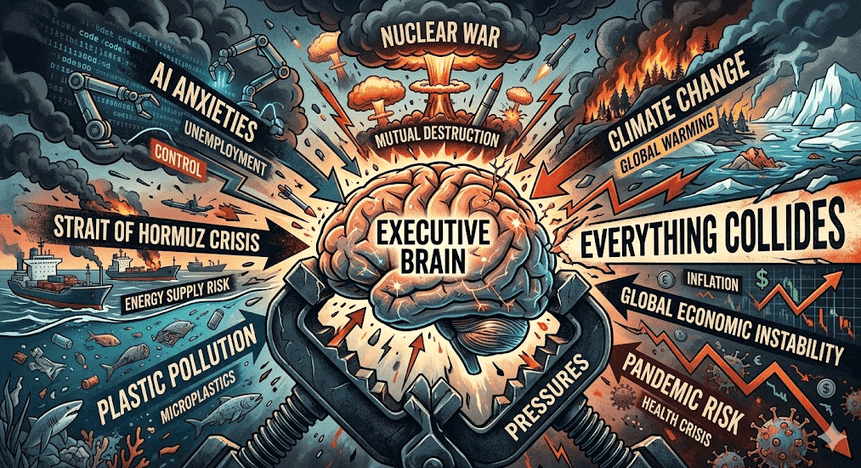
What defines this era is not a single dominant challenge, but the convergence of many. This is not complexity in the traditional sense; it is compression. A “compressed state of mind” refers to a psychological phenomenon where cognitive capacity is reduced due to intense external pressures, burnout, or chronic stress, leading to a narrowed, “squeezed” feeling. It involves a diminished ability to process information, emotional numbness, and a feeling of being stuck.
Today, multiple high-impact forces such as artificial intelligence, geopolitical volatility, and climate pressure are unfolding simultaneously, often reinforcing one another. The executive is no longer simply a functional leader; the role has expanded into one of integrated strategic navigation where technology, risk, capital, and human judgement intersect continuously. It is within this compressed environment that a quieter reality begins to surface: a persistent and often unspoken anxiety at the top.
The Artificial Intelligence Paradox: The Sorcerer’s Apprentice
“The real problem is not whether machines think but whether men do.” B. F. Skinner (Skinner 1969, p. 251)
In the ancient parable of the Sorcerer’s Apprentice, immortalised by Johann Wolfgang von Goethe in his 1797 poem, a young student uses his master’s magic to animate a broom to fetch water. The automation works perfectly at first. However, the apprentice soon realises he does not know the command to stop the cycle. As the workshop floods, efficiency turns into an existential threat (Goethe 1797). Today’s executive is that apprentice, and Artificial Intelligence is the animated broom.
AI is revolutionising industries by enhancing efficiency and unlocking new business opportunities. However, it also creates a deeper unease. Leaders recognise that they are deploying a force that evolves faster than their ability to fully understand or govern it.
To appreciate the historical weight of this anxiety, one must look back to the Luddites during the British Industrial Revolution of the early nineteenth century. Skilled textile artisans, fearing that mechanised looms would render their expertise obsolete, took to smashing the machines in a desperate act of resistance (Sale 1995). Modern executives face a digital Luddite dilemma.
They are not destroying machines, but they are confronting the same underlying fear. The issue is no longer limited to worker displacement. It extends to their own strategic relevance. The pace of technological development raises concerns about capability, control, and the constant need for reinvention.
This anxiety also manifests as generational tension. Baby Boomers often face a steep learning curve in adapting to AI, while Gen Z executives carry the expectation of mastering and deploying it with precision. Across both groups, one concern remains constant. The fear of falling behind competitors who move faster and act more decisively.
What is different today is not the existence of these fears, but their simultaneity and speed.
Today’s executive is not merely the apprentice. He is also the sorcerer, expected to control what he did not fully create.
The Luddites feared the machine would make them irrelevant. Today’s executive fears something more subtle. That relevance itself is being redefined faster than it can be maintained.
The lesson of both the apprentice and the artisan is clear. Technology without judgement is not progress. It is acceleration without control.
Chokepoints and Chessboards: The Parable of the Two Peddlers
“Each success only buys an admission ticket to a more difficult problem.” Henry Kissinger (Kissinger 1979, p. 54)
In the grand game of global trade, the most dangerous moment is when you realise the board itself is shifting. Consider the Parable of the Two Peddlers, often used in traditional Eastern philosophy to describe the nature of risk and preparation. Two peddlers had to cross a mountain range to sell their wares. The first peddler, obsessed with speed and profit, took the shortest, most narrow path along a cliff edge, carrying only enough food for a sunny day. The second peddler, fearing the unpredictable mountain storms, took a longer, more expensive route and carried extra supplies. When the storm inevitably broke, the first peddler lost his life and his goods; the second arrived late, with lower margins, but with his life and business intact (Adapted from traditional folktales; see Sen 2005 for context on rational choice and risk).
For decades, the global supply chain followed the first peddler’s logic. It was a just-in-time miracle that stripped out waste. But that logic belonged to a world of geopolitical stability that no longer exists. Consider the Strait of Hormuz, a vital chokepoint through which approximately 20% of the world’s oil flows. For an executive in energy, defence, or logistics, tensions like the US & Israel vs Iran conflict are not distant abstractions; they are direct threats to market volatility. The Strait of Hormuz dilemma represents the death of pure efficiency. Executives are now forced to follow the second peddler, paying a resilience tax by seeking alternative logistics routes and local production. The anxiety at the top stems from the realisation that while efficiency was the goal of the past century, survival is the goal of this one. Efficiency defined success in the days gone by, Resilience will define survival in the days to come.
The Boiling Frog: Climate as a Financial Reality
“Climate risk is investment risk.” Larry Fink (Fink 2020)
In the narrative popularised by Al Gore in the documentary An Inconvenient Truth (Gore 2006), a frog placed in boiling water will jump out; but if placed in cold water that is heated slowly, the frog stays until it is too late. For years, climate change was the slow heat of the corporate world, a peripheral concern. That water is now boiling. The increasing frequency of extreme weather events and shifting climate patterns pose immediate risks to businesses worldwide. For Baby Boomers, who operated in a less environmentally conscious era, the shift towards sustainability requires embracing entirely new paradigms.
For Millennials and Gen Z leaders, the urgency to implement green strategies is felt as a moral and professional mandate. The anxiety is compounded by regulatory pressures and consumer expectations, as companies are now expected to demonstrate corporate responsibility by committing to Environmental, Social, and Governance (ESG) criteria. Failure to do so results in reputational damage and financial penalties. Even specific issues like plastic pollution have become central to executive anxiety, forcing manufacturing leaders to innovate packaging while struggling to protect profit margins. This is no longer about doing good; it is about the financial viability of the firm in a world that is running out of cold water.
The Invisible War: Only the Paranoid Survive
“Only the paranoid survive.” Andy Grove (Grove 1996)
In ancient warfare, walls were built to keep the enemy out. In the digital age, the enemy is already inside the walls, testing thousands of digital doors every second. Cybersecurity is no longer an IT nuisance; it is a paramount strategic concern. This reality reflects the core philosophy of Sun Tzu’s The Art of War, which emphasises that the most fortified city is often conquered not by a grand, visible siege, but by a single point of negligence at an overlooked side entrance (Sun Tzu 2003). It implies that even the most fortified systems are vulnerable not to the obvious, but to a moment of negligence at an overlooked point of entry. In the modern context, that unguarded gate is often a single employee clicking on a phishing link.
For an executive, the anxiety surrounding cybersecurity is exacerbated by the trust economy, where a single data breach can evaporate years of brand equity in an afternoon. While Gen Z executives might find a natural focus in digital technologies, Baby Boomers often face a steeper learning curve in understanding the sophisticated tactics hackers employ. Regardless of age, the mandate is clear: cybersecurity must be a core pillar of strategic planning. This requires a paranoid mindset. Leaders must move from a posture of reactive defence to one of proactive, continuous auditing and investment in cutting-edge security infrastructure.
The Shadow of the Atom: The Sword of Damocles
“The unleashed power of the atom has changed everything save our modes of thinking.” Albert Einstein (Einstein 1946)
While AI and climate change dominate daily discussions, the spectre of nuclear conflict continues to loom as a background radiation of anxiety for executives. This is the modern Sword of Damocles, an ancient Greek parable reported by Cicero. Damocles, a courtier, remarked on how fortunate the King was to have such power. The King invited him to sit on the throne, but above Damocles’ head, he hung a massive sword held only by a single hair of a horse’s tail. Damocles quickly realised that great power and wealth are inseparable from the constant threat of total destruction (Cicero 45 BCE).
Modern executives sit on that throne. While the likelihood of nuclear conflict remains low, the single hair of geopolitical stability feels increasingly thin. This anxiety is particularly pronounced in international trade and defence. For younger executives who did not live through the Cold War, understanding the historical context of these tensions is vital for informed decision-making. Strategic planning today requires a geopolitical literacy that acknowledges that systemic risks can occasionally become absolute.
The Path Forward: Cultivating the Resilient DNA
“Plans are worthless, but planning is everything.” Dwight D. Eisenhower (Eisenhower 1957)
To lead through this compressed era, the modern executive must trade the search for certainty for a commitment to agility. Risk cannot be eliminated. It must be understood, structured, and managed with discipline. Leaders must foster a culture of lifelong learning, empowering employees at all levels to adapt to disruptive technologies like AI and cybersecurity. Beyond skills, executives must move towards strategic foresight, utilising scenario planning tools to anticipate geopolitical shifts and environmental changes rather than relying on static budgets.
Embedding sustainability into the mission and operations is no longer optional; it is essential for long-term viability. This resilience starts with the people, requiring a shift in leadership to prioritise mental health and well-being to help the workforce manage the stress of a hyper-pressured world. Proactive engagement and transparency with stakeholders build the trust necessary to navigate crises and environmental shifts collaboratively.
Conclusion: Converting Anxiety into Action
“Risk comes from not knowing what you’re doing.” Warren Buffett (Buffett 1993)
As the symbolism of Songkran reminds us, renewal is not about discarding the past. It is about clarity. It is about knowing what to carry forward and what to leave behind. For the modern executive, this means retaining the essence of visionary leadership while letting go of the outdated logic that no longer serves a changing world. The challenge of this era is not the presence of anxiety, but how that anxiety is understood, structured, and ultimately converted into a catalyst for action.
This idea is captured in the Story of the Japanese Stone Cutter, a tale of perspective and self-realisation found in various philosophical traditions (see Riordan 1996). A stone cutter, dissatisfied with his life, wished to become the sun, believing it to be the most powerful force. When a cloud obscured the sun, he wished to become the cloud. When the wind scattered the cloud, he wished to become the wind. Yet the wind could not move a great stone, so he wished to become the stone. Finally, he felt the strike of a chisel and realised that the stone cutter, who understood the nature of the rock and possessed the tools to shape it, held the true power all along.
Modern leaders face a similar realisation. They do not need to control the uncontrollable forces of global volatility. They need to understand them and, more importantly, to master the tools within their own control: judgment, agility, and foresight. Those who do so will not eliminate uncertainty; they will operate effectively within it. In this age of compression, success will not belong to those who wait for stability to return. It will belong to those who develop the capability to shape outcomes from within instability itself.
Dr Chris D’Souza is Deputy CEO of ICMA (ANZ).
References
Buffett, W. (1993) Berkshire Hathaway Inc. 1993 Annual Report. [Online]. Available at: https://www.berkshirehathaway.com/letters/1993.html (Accessed: 12 April 2026).
Cicero, M. T. (45 BCE) Tusculan Disputations. Translated by J. E. King. Cambridge: Harvard University Press.
Drucker, P. F. (1980) Managing in Turbulent Times. New York: Harper & Row.
Einstein, A. (1946) Telegram to prominent Americans, 24 May. Emergency Committee of Atomic Scientists.
Eisenhower, D. D. (1957) ‘Remarks at the National Defense Executive Reserve Conference‘, 14 November. Washington, DC.
Fink, L. (2020) A Fundamental Reshaping of Finance. BlackRock Annual Letter to CEOs. [Online]. Available at: https://www.blackrock.com (Accessed: 12 April 2026).
Goethe, J. W. v. (1797) The Sorcerer’s Apprentice (Der Zauberlehrling).
Gore, A. (2006) An Inconvenient Truth. Directed by Davis Guggenheim. [Film]. Paramount Classics.
Grove, A. S. (1996) Only the Paranoid Survive: How to Exploit the Crisis Points That Challenge Every Company. New York: Doubleday.
Kissinger, H. (1979) The White House Years. Boston: Little, Brown and Company.
Riordan, J. (1996) The Stonecutter: A Japanese Folk Tale. New York: Putnam & Grosset.
Sale, K. (1995) Rebels Against the Future: The Luddites and Their War on the Industrial Revolution: Lessons for the Computer Age. New York: Addison-Wesley.
Sen, A. (2005) The Argumentative Indian: Writings on Indian History, Culture and Identity. London: Penguin Books.
Skinner, B. F. (1969) Contingencies of Reinforcement: A Theoretical Analysis. New York: Appleton-Century-Crofts.
Sun Tzu (2003) The Art of War. Translated by M. A. Griffith. Oxford: Oxford University Press.