



Overview
In today’s uncertain trade environment, the cost of raw material ingredients of a manufactured product can change dynamically due to tariffs, inflation, sanctions, embargoes, supply chain disruptions, and multiple other factors. Consequently, today’s standard costing systems are ill-equipped to handle various costing and pricing issues that may arise.
How these issues are handled by a company’s cost management system can significantly impact a company’s financial health and competitive positioning. In manufacturing firms, especially in the Fast Moving Consumer Goods (FMCG) industry, there are further impediments to dynamic costing and pricing due to labelling laws and safety regulations.
This article particularly focuses on the reformulation of food products to meet specific price and profit objectives. The article seeks to determine the prevalence of this reformulation in the manufactured food industry, the obstacles it faces, and the potential benefits or drawbacks of Artificial Intelligence (AI) and print-on-demand technologies in these dynamic market conditions.
Reformulation of Ingredients in the Australian Food Manufacturing Industry
Regulation pertaining ingredient lists on labels
There is a set of regulations companies have to adhere to when selling packaged food in Australia.
Companies are required to label ingredients in descending order, from the highest weight to the lowest. Packaged food must also show the percentage of the “key or characterising ingredient”, according to Food Standards Australia New Zealand — the organisation that regulates food labelling (https://www.foodstandards.gov.au/).
For example, a cereal marketed as containing ‘oats’ must give the percentage of oats, and a ‘strawberry yoghurt’ must show the percentage of strawberries.
Reformulation is adjusting a recipe like one would do at home if one was on a budget. Reducing higher-value items, which contribute the highest cost, while maintaining flavour and nutrition elsewhere is the goal. Such reformulations, where significant, would require the relabelling of the product.
Significant variations in main ingredient in formulations
In a comprehensive study done by the Australian Broadcasting Corporation (ABC), about 11,000 food products listed on the Australian retail giant Woolworths’ website (https://www.woolworths.com.au/) were looked at to document the percentage changes for the main or “characterising” ingredient — like raspberries in raspberry jam — across a 15-month period.
The study used data collected by Adam Williamson, a data scientist, in the period between April 1, 2024 and July 1, 2025 (Glover, 2024). Note that although the other Australian retail giant Coles’ ingredients information was not in the dataset due to Mr Williamson’s difficulty collecting it, most of the products on the list are also available at Coles, IGA and other Australian food retailers.
The products studied included ice cream, meat, dips, jams, cereal and packaged meals, with some brands represented more than others. The results were staggering; there were significant reformulations happening across the board (Chwasta, Bonica, and Noonan, 2025).
The study found that corporate ‘Brands’ were generally more cautious about changing recipes compared with Private Label products (store brands). The reason is that, usually, Brands must stand behind the overall quality – if they have changed a product or someone buys it and they take it home and they realise it has changed, they may lose that customer.
Table 1: How the main or characterising ingredient in dozens of Retailer private label products has changed
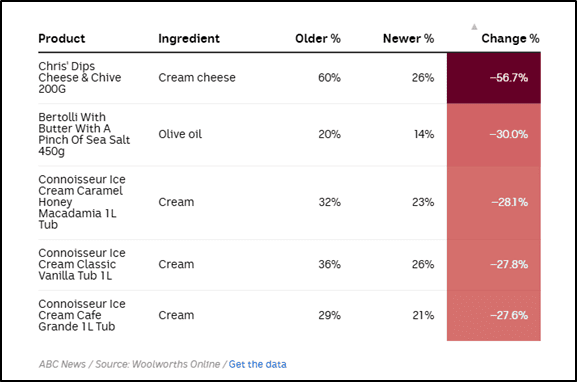
However, it is a different story with regard to retailer private labels. This is because there is a lot less risk for retailers if they disappoint customers with their own store brand—because the customer will return to the store anyway and buy a different product, for which the retailer still gets a sale.
To investigate this phenomenon more, the ABC investigators questioned Woolworths about several of its home-brand products where the main ingredient was reduced, some by as much as a staggering 56% (see Table 1)
A spokesperson for the retailer said the company was aware of cost-of-living pressures and that the recipes for some of its products had been changed to keep prices lower compared to similar items.
“We review our own brand product pricing, quality and composition from time to time for a number of reasons, including to meet customers’ preferences and ensure compliance with changes to food labelling regulations. In some cases, as a result of reviews, we make updates to product formulation, including to allow us to lower some ingredient costs and keep prices low and improve appearance and flavour.” (Chwasta et al., 2025).
Reasons for changes in formulation
The ABC investigators selected 47 products where the main ingredient appeared to decrease in proportion, according to the label, and contacted the manufacturers as to the reasons why. The study found that it was often not clear what exact ingredients had replaced the decreased proportion.
While some manufacturers said their changes were to improve the recipe, others said they were due to supply chain cost increases and wanting to keep the price of the product low. Similar changes, where the quality of the product decreases but the weight and price stay the same, have been labelled as “skimpflation” in overseas media. The phrase is a nod to “shrinkflation”, where the weight or size of a product gets smaller and the cost holds, meaning consumers pay the same for less product (Flemming, 2025).
Labelling Changes
The main reasons given for labelling changes were:
- Supply-chain difficulties: The study was over the 15-month period from April 1, 2024 and therefore the impact of the Trump tariffs would have only been at the last few months. Since the easing of Covid-19-related supply chain shocks, there have been other supply chain disruptions, such as extreme weather events caused by climate change; protracted regional conflicts in Eastern Europe and the Middle East; escalating tensions in the South China Sea; and pirates choking sea supply lines in the Red Sea. This will result in labelling changes regarding country of origin. If a food manufacturer switches to a different source of an ingredient due to supply issues, the ingredient list on the label may need updating to reflect this change. Further, new suppliers’ materials might not comply with regulations such as a country’s labelling requirements, necessitating additional testing and certification.
- Improving recipes for taste and texture: Abbott’s Bakery (George Weston Foods) told the ABC investigators that the reduction of wholegrain wholemeal wheat flour in its bread was made after “extensive research and testing” to improve the taste and texture, with more wheat flour and malt wheat flour introduced to the recipe. Cobs also said its cheese popcorn was given extra cheese flavour — at the expense of popcorn.
- Factory machinery changes: As more and more manufacturers are converting to flexible manufacturing systems and robotics, higher levels of accuracy in formulations are possible. The Arnott’s Group said that factory machinery changes required changes in formulations in its 200g Kingston Cream Biscuits and its 500g Campbell’s Country Ladle Soup Garden Vegetable & Wholegrain Barley products. Such changes usually result in labelling changes.
For products where the main ingredient actually increased, it was generally unclear as to what was replacing these ingredients. Australia’s laws state that most ingredients only need quantities, not percentages. Of the companies that responded to the ABC’s questions, only some provided detailed information about what had replaced the decreased ingredient.
Cost Considerations
Interestingly, Cost considerations were not specifically listed as a reason for changes in ingredient formulations.
However, most retail experts agree that inflation was likely a big contributor to these formulation decisions as input costs in most countries have gone up (Asher, 2024). The Food Manufacturing Input Index, a metric produced by the Australian Bureau of Statistics, reflects the rise in costs, as shown in Table 2.
Table 2: Percentage change in food product manufacturing input index compared with March 2015.
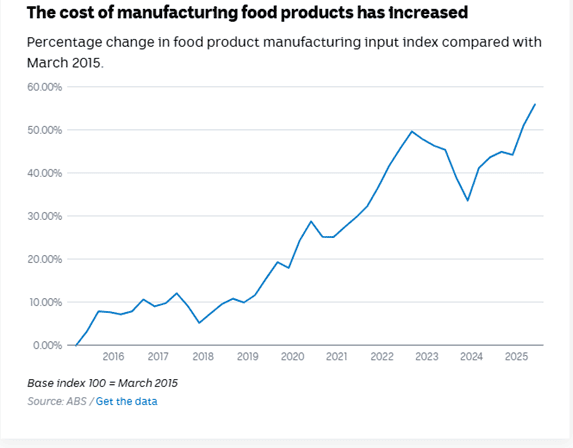
The metric looks at the change in cost of the ingredients that go into making food products, as well as electricity, gas, paper and cardboard, and shows how the price of these has risen — especially during COVID.
Traditional Manufacturing Challenges in Processed Food Manufacturing
In the area of reformulation of ingredients, there are currently many challenges to dynamic pricing and costing, such as:
Cost Fluctuations: Changes in the cost of raw materials directly affect the cost of goods sold (COGS). This variability can make it difficult to maintain stable profit margins. Fluctuating raw material costs can lead to budget overruns or require frequent revisions to financial forecasts. For example, if the price of a key ingredient like cocoa for a chocolate manufacturer rises due to supply shortages, the production cost per unit increases.
Price Adjustment Lag: There is often a delay in adjusting retail prices to reflect increased costs, which can temporarily squeeze profit margins.
Customer Sensitivity: Frequent price changes might alienate customers or lead to decreased demand if competitors do not follow suit. For example, a bakery might face customer pushback if it frequently adjusts prices for its bread products due to fluctuating flour costs.
Inventory Management Issues: One such issue in this area is Stockpiling vs. Just-in-Time. Companies may face decisions about whether to stockpile raw materials when prices are low, which can tie up capital, or rely on just-in-time inventory, which can be risky if prices rise unexpectedly. Another issue is Obsolescence Risk, i.e., holding excess inventory of raw materials that may become obsolete or lose value if demand shifts.
Supply Chain Disruptions: Companies heavily reliant on a few suppliers for key ingredients may face significant disruptions if those suppliers encounter problems. For example, a beverage company relying on a single supplier for a unique flavouring might face production halts if that supplier has a supply chain breakdown.
Companies may need to diversify their supplier base to mitigate risks associated with reliance on a single supplier. For example, a food processing company might source wheat from multiple suppliers in different regions to mitigate risks of regional crop failures. This strategy can provide more flexibility and bargaining power. However, this can be a problem if the suppliers are subject to different tariffs or fall foul of sanctions.
Contractual and Legal Challenges: Companies with long-term supply contracts might benefit or suffer based on how raw material markets fluctuate. For example, a fixed-price contract might protect against rising costs but could be disadvantageous if prices fall.
How AI Could Further Disrupt Food Formulation, Costing and Pricing
Let us take the case of the simple product, a pack of ‘tea bags’.
A large manufacturer, say like Lipton APAC, will ask its buying agents (say domiciled in Australia) for a particular grade of tea leaves for a specific blend. The buying agent asks a broker (say domiciled in Sri Lanka) to send samples of the tea leaves that are coming up for auction. The samples are couriered to the buying agent, who then tells the broker the quantity and maximum price at which to buy the tea leaves. The broker does this and ships the tea to the buying agent, who then ships it to Lipton (APAC). In addition to the cost of the tea leaves, there is bank interest, warehousing and shipping costs and tariffs involved. These can vary depending on the economic and trade conditions prevalent at the time.
Exporting tea also requires compliance with various certifications and regulations to ensure quality, safety, and sustainability. Lipton ultimately bears these costs and the middleman’s fees. However, Lipton most likely will have a fixed-price contract with a retailer such as (say) Woolworths in Australia. As such, it will change formulations to achieve the best profit margin while still maintaining an acceptable taste and quality of its offerings. It will also need to ensure that its labels (which are pre-printed on its boxes) are accurate within the flexibility allowed by law.
Much of the above process can be significantly speeded up by AI agents, especially in the area of reformulation by blending different grades of tea leaves.
Impact of AI on Financial Planning and Forecasting
Dynamic Pricing
Companies had always needed to continuously analyse and adjust their pricing and cost structures to maintain desired profit margins. However, with AI, this can be done on a real-time basis. Already we are seeing dynamic pricing in the transportation (Uber) Airline (Delta) and Hotel (Booking.com) industries.
Dynamic pricing in food manufacturing involves adjusting prices based on various factors such as demand, production costs, market conditions, and competition. This strategy allows manufacturers to optimise revenue and manage inventory more effectively. Here are some examples of how dynamic pricing is utilised in the food manufacturing industry.
A fruit juice manufacturer may increase prices during off-season periods when raw materials like certain fruits are less available and more expensive. Conversely, during peak harvest times, when fruit supply is abundant, prices may be lowered to encourage sales and manage inventory. AI will provide this demand and supply information on a real-time basis.
A cereal manufacturer might use dynamic pricing to match or beat competitors’ promotions. If a competitor offers a discount on a similar product, the manufacturer may temporarily lower their prices to remain competitive in the market. AI agents will alert the manufacturer of the competitors’ promotions and their impact on the company’s sales on a real-time basis.
A manufacturer of canned soups might offer dynamic pricing to wholesalers or retailers, providing discounts for larger orders to encourage bulk purchasing and reduce warehousing costs.
The biggest impact of AI is on real-time online pricing. For example, an online food retailer might use algorithms to adjust prices in real-time based on website traffic, competitor pricing, and stock levels. For example, if a particular product is trending or receives high traffic, the price might be temporarily increased to capitalise on demand.
Dynamic Pricing will lead to Cost-Driven Pricing Decisions. For example, if a dairy manufacturer experiences an increase in milk prices due to supply chain disruptions, they might adjust the prices of their cheese and yogurt products accordingly to maintain profit margins.
This requires a cost management system that can keep pace with the real-time demands of Dynamic Pricing.
Dynamic Cost Accounting
AI coupled with real-time granular costing has the potential to dynamically attach changes in input costs that will lead to a more sophisticated cost accounting system in which costs are accurately attached or allocated in order to maintain financial transparency. This will be the greatest impact of AI.
‘Standard Costing’ (with its variances at the end of a reporting period) will be replaced with ‘Dynamic costing’ where every change in formulations will generate a new standard. This will lead to a very sophisticated system of ‘Actual Costing’, where materials, labour and overhead will be at actual costs.
Traditionally, with standard costing, a manufacturing firm needed to update its standard costing methods frequently to ensure accurate financial reporting. With ‘Dynamic Costing’, this will be done on a real-time basis as product formulations change.
Dynamic Product Reformulation
With the advent of AI agents, changes in raw material availability or costs that may necessitate reformulating products to maintain cost-effectiveness or meet regulatory standards can be instantly analysed by obtaining information from multiple sources. For example, a beverage company might need to reformulate its drink recipes if a key ingredient becomes too expensive, ensuring the product remains profitable while maintaining quality. With traditional manufacturing methods, the company’s chemists and food technologists will take weeks to collect this information and then further time to test out new formulations.
AI will open new opportunities in volatile raw material markets. The use of AI agents might encourage companies to explore alternative materials or innovate with new products that use less costly or more sustainable ingredients. For example, a company might develop a new line of eco-friendly packaging in response to rising costs of traditional materials.
AI-Driven Product Re-Formulation: The Relabelling Challenge
When food ingredients are changed dynamically, several challenges related to labelling and food standards can arise. These challenges are crucial as they impact compliance with regulatory requirements, consumer trust, and brand reputation. Relabelling is definitely the biggest challenge facing food manufacturers. Whilst AI agents can dynamically speed up the reformulation process to meet seasonal, environmental, supply chain and pricing constraints, it cannot at present change printed labels on processed food products dynamically.
Frequent ingredient changes necessitate redesigning and reprinting labels, which can be costly and logistically challenging, especially for large product lines. This is the most significant challenge of dynamic product reformulation using AI Agents. In the case of digital products such as hotel reservations, airline tickets or uber rides, there are no labels that have to be changed.
But with processed food products sold via supermarkets, dynamic product reformulations must be reflected in product labels. The costs can be exorbitant. A beverage company may incur significant costs if it has to continually update the labels of its various drink flavours due to changing sweeteners.
It must be remembered that incorrect labelling due to ingredient changes can lead to legal action if consumers suffer adverse effects, such as allergic reactions. A mislabelled product that fails to disclose the presence of an allergen can result in lawsuits and damage to the brand’s reputation.
Managing existing inventory with old labels can be challenging. Companies must decide whether to use up existing label stock or discard it, which can lead to waste. A manufacturer might face a dilemma on whether to sell off existing stock with outdated labels or replace them, balancing cost against compliance and consumer trust.
Companies exporting products need to ensure that their labels meet the regulatory standards of each country they operate in, which can vary significantly. A food company exporting to both the EU and the US will need to adjust its labelling to meet the differing allergen and nutritional labelling requirements of each market. Ingredient changes might also need to consider cultural preferences or restrictions, such as halal or kosher certifications for those exporting to Muslim or Jewish countries.
Similarly, introducing an animal-derived ingredient in a product previously marketed as vegan or vegetarian can require certification changes and can affect marketability in certain regions.
Given such labelling constraints, it can be envisaged that in the not-too-distant future, the modern advances that we have seen in print-on-demand technologies could be expanded to FMCG product labels, where the label is considered just another raw material ingredient that can be printed on demand at the time of finishing and packaging each product individually. Another possibility is that legislation may be changed so that all FMCG products require having QR codes that can reveal their ingredient compositions on customers’ phones, rather than on printed labels.
Conclusion
In an environment where food ingredients change dynamically due to cost fluctuations, supply chain disruptions, or market demands, businesses face a multitude of challenges related to labelling and food standards. These challenges encompass regulatory compliance, allergen management, and maintaining the validity of health claims, all of which are crucial for ensuring consumer safety and trust.
Companies must also navigate the complexities of marketing and branding, as ingredient changes can affect product positioning and brand perception. The logistical and financial implications of updating labels and managing inventory further add to the complexity, requiring strategic planning and resource allocation.
Furthermore, in the global market, ensuring compliance with diverse international standards and cultural sensitivities is vital for maintaining market access and competitiveness. Lastly, businesses must remain committed to consumer experience through rigorous product testing, ensuring that quality and sensory expectations are consistently met.
Overall, while dynamic ingredient changes pose significant challenges, they also present opportunities for innovation and improved supply chain resilience. By proactively managing these changes through transparent communication, strategic sourcing, and adaptive marketing strategies, companies can maintain brand integrity and consumer trust while navigating the complexities of modern food production and distribution
References
Chwasta, Madi; Bonica, Danielle and Noonan, Andie (2025) “The changes hidden within ‘cryptic’ supermarket ingredient labels”, ABC News, Oct 5. https://www.abc.net.au/news/2025-10-05/supermarket-ingredients-changes-skimpflation/105478516
Chwasta, Madi (2024), “Grocery prices at Coles and Woolworths go up and down. What’s behind the pattern?”, ABC News, Oct 26. https://www.abc.net.au/news/2024-10-26/coles-woolworths-supermarket-price-specials-cost-of-living/104470674
Flemming, Tessa (2025), “ACCC pushes for supermarkets to publicise size changes in shrinkflation crackdown”, ABC News, March 21. https://www.abc.net.au/news/2025-03-21/accc-inquiry-pushes-for-more-shrinkflation-transparency/105079848
Glover, April (2024), “Adam was sick of fluctuating grocery prices, so he figured out a way to game the system”. 9 News, Aug 27. https://www.9news.com.au/national/data-scientist-adam-williamson-internet-browser-extension-monitoring-supermarket-prices/
Asher, Lisa (2024), Submission to NZ Commerce Commission Opposing the Foodstuffs North Island and Foodstuffs South Island Merger, University of Sydney, Feb 9. https://www.comcom.govt.nz/__data/assets/pdf_file/0025/343735/FSNI-and-FSSI-merger-Lisa-Asher-submission-in-response-to-Statement-of-Preliminary-Issues-9-February-2024.pdf
ABS (2025), Producer Price Indexes June 2025, Australia, Australian Bureau of Statistics, Aug 1, https://www.abs.gov.au/statistics/economy/price-indexes-and-inflation/producer-price-indexes-australia/latest-release