

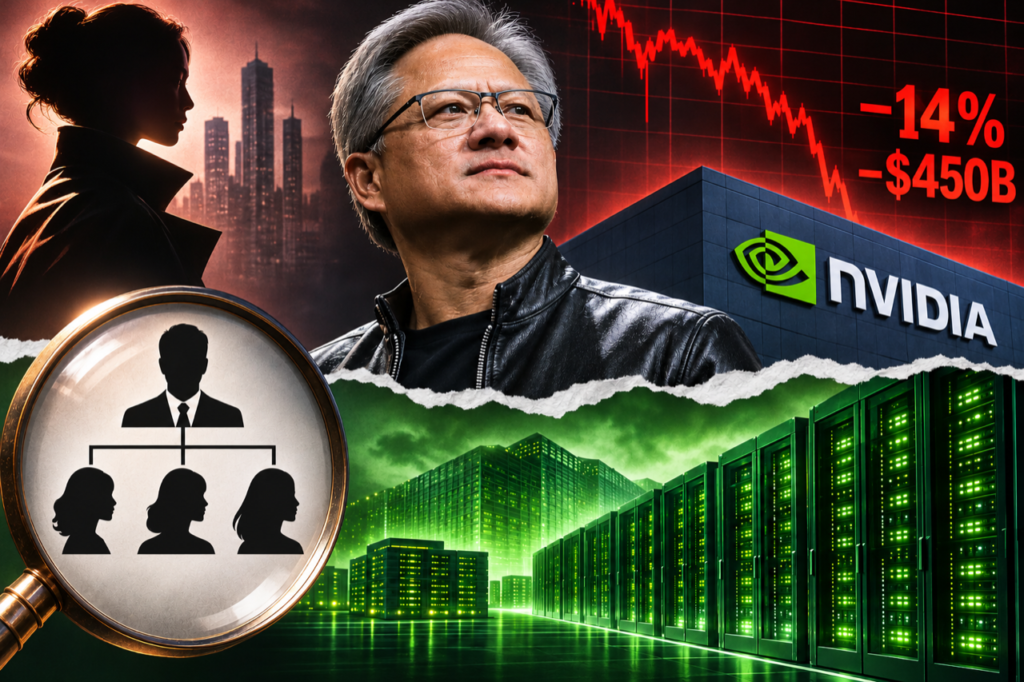

The Drama: Hollywood Spy Thriller
“I am Huang, Jensen Huang”
The whole business world knows the story. But it is still evolving on an hourly basis.
In mid-November 2026, Nvidia co-founder and longtime CEO Jensen Huang abruptly resigned after 33 years at the helm following a series of personal and national security scandals that wiped US$450 billion (and counting) off the chipmaker’s market value (John, 2026).
It started with a story that broke on October 29, 2026, in the New York Times that American spy agencies were investigating a Singapore-based data centre company Megaspeed, the biggest buyer of Nvidia chips in South-East Asia, for possibly steering advanced Nvidia AI chips to China despite US export restrictions (Culper, 2026).
These American intelligence officials had also gathered striking intelligence that a top executive at Megaspeed was also a Chinese intelligence asset, funnelling information to Beijing. But what came next was even more alarming to them. Surveillance had shown that Jensen Huang had developed a close relationship with this executive, a Chinese citizen named Alice Huang (no relation), (Swan, et., al., 2026).
U.S. intelligence and Singaporean authorities reportedly suspected she had been recruited by Chinese intelligence, raising alarms that Megaspeed was being used to bypass U.S. export controls and funnel restricted AI chips into China. It must be noted that Beijing calls the allegations unsubstantiated and Megaspeed says she left in August 2025 (Jordan and Jamali, 2026).
Then, on November 8, 2026, Jensen Huang publicly apologized for being unfaithful to his wife. Days later, on November 11, 2026, The New York Times reported he had also engaged in an affair with Kimberly Powell, a direct subordinate at Nvidia (with Reuters subsequently reporting a third relationship with another unnamed employee) (Mac; Mickle and Gee, 2026).
After the story of the reported relationship with a company employee broke, Jensen Huang’s position as CEO appeared untenable. This then raised many questions from a finance and governance perspective, which were of interest not only to management accountants, but to the global investing community as well, such as:
- Who is Jensen Huang?
- Can a board really fire the man who built a US$5 trillion company?
- What happens to the share price if this person leaves the company?
- What happens to his shares and to those who invested in the company directly or via investment funds?
- And what does history tell us about companies who remove their own founders?
- How did Nvidia become a US$ 5 trillion company in just a few short years?
It is the answer to the last question that will surprise most readers.
Nvidia, like many tech companies became a trillion-dollar company in just a few short years. with a financing sleight of hand called ‘Circular financing’ (or ‘Round-tripping’), and which is very similar to methods used by tax avoiders and Bitcoin investors (Ratnatunga, 2021).
Circular financing in the AI infrastructure sector refers to a closed-loop capital structure where a chip manufacturer like Nvidia uses its balance sheet – through equity investments, lease guarantees, and capacity buybacks – to help data centre operators (called ‘neoclouds’) and Frontier AI labs (like OpenAI – the maker of ChatGPT) raise massive debt from Wall Street lenders and build out infrastructure (Data Centres) that is then used to purchase Nvidia’s own GPUs.
Neoclouds (such as CoreWeave and Nebius) need money to build data centre infrastructures and also buy AI chips by the hundreds of thousands to fill these data centres. Neoclouds then rent this data centre computing power to AI labs and other companies, competing with Amazon, Google and Microsoft. But how do Neoclouds and Frontier AI abs get the billions needed to build the data centres and buy the AI chips?
They get it from manufacturers like Nvidia, who invest in them via equity and debt, in order to facilitate the purchase of their own AI chips. Sounds complicated? I will explain the four steps required to make this happen in the last part of this article
Let us now answer the 6 questions raised above.
The Valuation: Key Person Risk
The Huang Identity
First, the short version of who Jensen Huang is and why he can single-handedly drive stock values throughout the economy. He co-founded Nvidia in 1993 and has been its chief executive every single day since, for 33 years. Almost nobody in corporate America has run one company for that long. In that time, Nvidia’s share price has risen by more than 700,000%. This means that US$1,000 invested at the start would be worth around US$7 million today. Nvidia makes the chips that train and run artificial intelligence. Every major AI company depends on them. That made Nvidia one of the most valuable companies in the world. And it made Huang something more than a chief executive. He was the company’s chief salesman. He personally negotiated with the biggest customers on Earth. He used Nvidia’s cash to invest across the AI supply chain, in startups, and in the very companies that buy his chips (more of this later, as it answers the last question). He was the industry’s loudest optimist and he was its diplomat, with a close relationship with President Trump and a long campaign in Washington to keep selling chips to China.
On 11 November, after the board report, Nvidia’s stock fell more than 8%. On a company worth around US$4.5 trillion (from a peak of US$ 5 trillion), that is roughly US$400 billion gone in one evening. More than the entire value of most companies on Earth.
Nvidia’s stock dropped roughly 14% over the week of the scandal (WSJ Staff 2026).
When the value of a company depends too heavily on one human being, it is known as ‘key person risk’. At most companies, key person risk is a line in the annual report that nobody reads. At Nvidia, at the end of that week, it became the only thing that mattered. So, let’s look at what the market did using a timeline (Herrera, 2026).
Tomorrow Never Dies
Market Reaction to News
On Thursday, October 29, 2026, the New York Times breaks the story. On Sunday, November 8th, Huang admits to an extramarital affair. On Monday, November 9th, the market gives its verdict. Nvidia falls more than 4.3%. On a US$4.5 trillion company, every 1% is about US$45 billion. So that is almost US$200 billion in a single session.
Tuesday, November 10th, another 5.5%, roughly US$250 billion more. The board hires a law firm to find out whether Huang was targeted by a foreign intelligence service, and whether any secrets were compromised.
Wednesday, November 11th the New York Times reports a second relationship, this time with Kimberly Powell, who runs Nvidia’s healthcare business and reports directly to Huang. The Times cites five people who worked at the company. Neither of them has confirmed it, and Nvidia declined to comment. One hour later comes the Wall Street Journal report that the board is preparing to oust him (Smagalla, 2026).. After hours, the stock drops between 8 and 9%.
Put together that is a fall of roughly 18%. About US$850 billion was lost between the prior Friday’s close and Thursday’s intraday low (Katanich, 2026), To put that in perspective, US$850 billion is more than the total value of almost every bank, every car maker, and every oil company in the world.
But nothing about the business had changed. The same chips, the same factories, the same customers, the same orders. The same cash flow from operations today. The only thing that changed in those 3 days was the answer to one question: “Will Jensen Huang still be here next month?”
The answer to that question impacts two key variables in any valuation model: (1) the expected future cash flow and (2) the cost of capital (discount rate). Key person risk moves the discount rate in terms of both the cost of equity and the cost of debt.
Although Jensen Huang has now resigned from the CEO job and board, it is still unclear as to what the answer to that question will be.
For Your Eys Only
The Huang Ultimatum
The impact of the two affairs with regards to crisis management and board responsibilities is very different. The spy story is dramatic, but murky. It depends on what intelligence agencies can prove. Also, many conspiracy stories have started: that Washington leaked the story as they thought Huang was too powerful; that competitors leaked the story, etc. etc.
It is the second story of an affair with an employee that the board needed to act on. An affair between a chief executive and someone who reports to him. He controls her pay, her promotion, and her career. McDonald’s fired its chief executive for having a relationship with an employee in 2019. Intel’s chief executive resigned over it in 2018. For a board, this is not a question of morality. It is a question of the rules that every other employee has to follow.
But what can a board do about a founder, the one and only CEO it had ever had, and one that had a hand in every major contact that had grown the company to a trillion-dollar behemoth? What can those directors actually do? Can they issue an ultimatum that he resigns or be fired?
At Nvidia, one share gives a shareholder one vote. There is no class of shares with special voting rights. Every share gets exactly one vote. Shareholders use those votes to elect the board of directors. And the board has one power above all others. It hires the chief executive, and it can fire the chief executive.
Jensen Huang holds just one seat on that board. The other directors can remove him as CEO with a simple majority. And, under Nvidia’s own rules, they can do it with or without cause. Think about what that means. They do not need any investigation to finish. They do not need proof of anything. They do not need the shareholders’ permission. They need a vote in one room on one evening.
According to Nvidia’s 2026 filing with the Securities and Exchange Commission, Huang owns about 870 million shares, worth about Nvidia has more than US$24 billion shares in total. So, the founder of Nvidia owns 3.58% of the shares, and thus 3.58% of the votes. He is not even the biggest shareholder. BlackRock holds about 7.4%. Vanguard holds about 7.3% (NVIDIA, 2026). Each of these asset management firms controls roughly twice as many votes as the founder.
Now compare that with Mark Zuckerberg, the founder of Meta (Facebook). Zuckerberg owns about 13% of Meta, but his shares are a special class. Each one carries 10 votes. That gives him around 60% of the voting power. Wall Street calls this dual class shares and it changes everything. Could Meta’s board fire Mark Zuckerberg? In practice, no. Because if the directors tried, he could vote to replace the directors. The founders of Google built the same wall. So did many others. It is the standard way a modern tech founder protects himself.
Jensen Huang never did it. When Nvidia went public in 1999, it sold ordinary shares. One share, one vote. And over the years, as Nvidia issued new shares and Huang sold some of his own, his slice got smaller and smaller until it reached 3.58%. For a quarter of a century, that did not matter. Nobody would vote against the man who made them rich. His protection was never legal. It was performance. It was trust. And that is the hard logic of this episode. Mark Zuckerberg is protected by a legal structure. Jensen Huang is protected by a reputation. A scandal cannot break a legal structure. It can break a reputation.
Live and Let Die
Could Huang be Fired?
Had Jensen Huang not stepped down as CEO, could the board have fired him? Yes, legally firing him would have been simple. But if they did fire him, exactly what does he lose monetarily? The surprising answer is not very much. Being chief executive is a job. Owning shares is property. They are two completely separate things. If the board had voted to fire Jensen Huang, he stops being CEO. He loses his office, his salary, and probably some future stock awards that have not yet been handed over, depending on his contract. But his 870 million shares stay his. Nobody can take them. At a company value of US$4.5 trillion, that stake is worth roughly US$170 billion.
Even after the fall in share price, he is still one of the richest people who has ever lived. Here is a detail that shows how strange this has been. A 17% fall in the stock means Huang’s own stake has dropped by roughly US$20 billion over the week the drama unfolded (Nitzberg, 2026). He has personally lost more money in a week than almost any chief executive will earn in 100 lifetimes. And he is still worth around 150 billion. That matters for one reason. In a normal company, a board has leverage over its chief executive because he needs the job. Jensen Huang does not need the job. He does not need the salary, and he does not need the stock awards. Whatever he decides to do next, money will not be the motivation that decides it.
Further, he would not automatically lose his seat on the board, should the board decide to fire him. Removing a director is a separate process. Therefore, in theory, Nvidia could have fired its CEO on Monday and then find him sitting across the boardroom table as a director on Tuesday.
Given all this, what was the board decision?
A source told CNBC the board decided the night before to oust him (Leswing, et al., 2026) However, they were spared from doing this as, on November 12, 2026, under mounting pressure from the board, federal investigators, and congressional committees, Jensen Huang stepped down as CEO, President, and board member. Nvidia named CFO Colette Kress as interim CEO and began searching for a permanent successor.
However, the drama does not end there. On November 13, an open letter – now signed by over 180,000 people—including Elon Musk, Epic Games CEO Tim Sweeney, and thousands of self-identified Nvidia employees—is actively campaigning for Huang’s reinstatement (Lee and Bhaimiya, 2026); even as Washington officials signal that bringing him back would face heavy regulatory scrutiny (Jordan and Jamali, 2026). However, Nvidia Chairman Harvey Jones said that the board is not considering bringing Huang back (Rooprai, et al., 2026).
The World is Not Enough
The Huang Legacy
What Jensen Huang will do next is still to be seen. One can only speculate. What would a man with around US$180 billion, with the most famous name in artificial intelligence, with every customer’s phone number, and with thousands of engineers who became wealthy working for him do after he leaves the company he founded.
Look again at the two biggest names on the shareholder list, BlackRock and Vanguard. They are not large shareholders with opinions. They are fund managers. They hold those shares on behalf of millions of ordinary people through index funds, pension plans, and retirement accounts. And Nvidia is one of the largest pieces of almost every major stock index in the world. If you own a fund that tracks the American market, a noticeable part of every dollar you put in goes to this one company. So, when Nvidia loses 17% in 3 days, it is not only traders who lose. It is teachers’ pension funds. It is retirement accounts. It is anyone who simply bought the market.
That creates a strange situation inside the boardroom. The directors are supposed to act for the shareholders. But the biggest shareholders are index funds and index funds do not pick sides. They cannot sell. They own Nvidia because it is in the index and they will own it with Jensen Huang or without him. So, what do these owners want? One thing: stability. And that is exactly the problem, because both choices are unstable.
Ask him back and the company lives under an investigation that could last months. Every new headline moves the stock. Every request to sell chips in China now comes with a question about a suspected spy. Washington holds a card it did not hold a before the story broke. Remove him and the market has to price something it has never priced before: Nvidia without Jensen. Huang runs a famously flat company. Around 60 executives reported directly to him. There was no traditional number two. Two of his children work at Nvidia, but according to the Wall Street Journal, neither has been named as a successor. Analysts spent this week searching for the plan and could not find one (Gardizy and Whelan, 2026).
Investors are split into two camps. The first camp says the company is still Jensen, even though he has resigned. As one analyst put it, he was the heart and soul of that company and without him it is not clear what they are. The second camp says that is nonsense, and that one cannot build a US$4.5 trillion company without some key people inside Nvidia who could step up and be outstanding chief executives. A new boss will not change the product line and will not end the AI boom.
So, who is right? We do not have to guess, because this experiment has been run before several times with real companies and real money.
You Only Live Twice
Lessons from History
The most famous case is Apple. In 1976, Steve Jobs co-founded Apple. In 1983, Apple had hired a professional chief executive, John Sculley, from Pepsi. in 1985 the two men fell out over the direction of the company, and the board had to choose. The board chose Sculley. Jobs was stripped of his role and in September 1985, he resigned. He was 30 years old. Now look at the numbers, because they are close to Huang’s situation in one important way. When he left, Jobs still owned about 5.5 million Apple shares, roughly 9% of the company. The board took his job. It could not take his stock. So, what did he do with it? He sold almost all of it, famously keeping a single share. And he used the money to start a computer company called NeXT and to buy a small animation studio that became Pixar.
And Apple? For a few years, Apple was fine. Sales grew. Sculley looked like the right choice. This is the part people forget. A company does not collapse the day its founder leaves. The damage came slowly. Apple lost its direction. Its products multiplied and its market share shrank. By 1996, it was losing enormous amounts of money and was desperate for new software. So, it bought NeXT for around US$400 million. And with NeXT came Steve Jobs. Within a year, he was running Apple again, at a moment when the company was, by his own account, weeks away from bankruptcy. What followed was the iMac, the iPod and the iPhone and one of the most valuable companies in the world.
So here is the lesson from Apple, and it has two halves. First half, Apple survived without its founder for 11 years. The business did not disappear. Second half, it did not become great again until he came back, and it had to pay hundreds of millions of dollars to get him. Firing a founder, in other words, can be a decision you end up buying back.
The second case tells the opposite story. Uber, 2017. The founder, Travis Kalanick, had built one of the most valuable private companies in the world. But after a long series of scandals about the company’s culture, Uber’s biggest investors forced him to resign as chief executive. Like Jobs, he kept his shares at first. He even kept his seat on the board. Uber brought in an outsider, Dara Khosrowshahi. Two years later, Uber goes public. Kalanick sells his entire stake, worth billions of dollars, leaves the board, and starts a new company called CloudKitchens. Uber keeps going. It grows. It becomes profitable. Today, most of its customers could not name the man who founded it. So, the lesson from Uber is simple. Sometimes the company really is bigger than the founder and sometimes removing him is exactly what lets it grow up. The same thing happened at Microsoft, where Bill Gates handed over to Steve Ballmer and then to Satya Nadella and the company became many times more valuable. It happened at Google after its founders stepped back.
But there is a third case, and it is the one that should worry Nvidia’s directors most. OpenAI, November 2023. The board fires its chief executive, Sam Altman, on a Friday afternoon. Legally, it has every right. Within days, more than 700 of the company’s roughly 770 employees sign a letter threatening to quit and follow him to Microsoft. 5 days after firing him, the board brings him back, and most of the directors who voted him out lose their seats. So, the lesson from OpenAI is the hardest one. A board has the legal power to fire a founder. That does not mean it has the real power. In a technology company, the most valuable asset is not the buildings or the patents. It is the people. And people can leave.
Now put Jensen Huang next to those three stories. Like Jobs, he walks away with his shares and with enough money to build anything he wants. Like Kalanick, he was pushed by scandal, not by bad results. The business itself has never been stronger. And like Altman, he led a company whose engineers are loyal to him personally and could be hired by a rival tomorrow. A person like Jensen Huang does not disappear. He becomes the most valuable free agent in the history of technology.
The Man with a Golden Gun
The Huang Conspiracy
There is a deeper reason the market is nervous. Nvidia’s business rests on a small number of very large relationships. A handful of giant technology companies buy a huge share of its chips and they order years ahead. Many of those deals were shaped by Huang in person. On top of that, Nvidia has invested its own money in AI startups and cloud companies which then spend that money on Nvidia hardware (Culper, 2026).
Nvidia does more than just sell AI chips to Neoclouds. It invests in them. For example, at the end of June 2026, Nvidia held about US$329 million in Nebius shares. Nvidia also guarantees their business. In July 2026, Nvidia began offering to rent back unused GPU capacity from neocloud partners at a fixed rate, a guarantee (either as a ‘floor’ or a ‘backstop’) that is meant to make banks more willing to lend to Neoclouds to build data centre capacity.
A ‘floor’ and a ‘backstop’ are closely related, but they are not the same thing. Both protect against downside risk, yet they differ in what they protect (a transaction/obligation vs. a price/rate) and who bears the obligation. A ‘floor’ is a contractual minimum price or rate below which an asset, interest rate, or payment cannot fall. A ‘backstop’ is a last-resort commitment by a third party (or underwriter) to step in and buy unsold capacity or cover a defaulted obligation if primary demand fails.
Nvidia has joined a US$500 billion financing platform with six institutional partners, of which Nvidia may backstop up to US$125 billion. This sits alongside over $108 billion in legally binding guarantees already in place, most notably a US$105 billion guarantee for OpenAI’s Ohio campus that Nvidia has already signed. These guarantees, now pose an issue for what lenders are pricing in terms of risk should Jensen Huang not be part of its future (Gioino, 2026).
The start of the circular financing loop is that Neoclouds and frontier labs need cash to buy Nvidia chips and build data centre capacity.
Step One: Equity Injections & Strategic Signalling: Nvidia takes direct equity stakes in emerging neoclouds and AI labs (holding roughly US$99 billion in equity stakes across its ecosystem as of mid-2026).
In Nvidia’s books: Dr. Share Investment; Cr. Cash (actual cash goes out)
In OpenAI’s books: Dr. Cash; Cr. Share Capital
Step Two: Capacity & Lease Backstops: Neoclouds and labs require tens of billions of dollars in capital expenditures to build power-dense data centres. To satisfy lenders, Nvidia signs take-or-pay capacity agreements (promising to rent back unused GPU capacity if third-party demand falls short) or lease guarantees covering data centre rent. These guarantees sit off-balance sheet as disclosed commitments and contingencies.
Nvidia’s stamp of approval signals creditworthiness to institutional investors and unlocks billions in follow-on equity and convertible debt, which is Step Three.
Step Three: GPU-Backed Debt Financing: Armed with Nvidia’s equity backing, guaranteed off-take contracts, and preferential allocation of next-generation GPUs, neoclouds borrow billions from private credit funds and banks—often using the Nvidia GPUs themselves as collateral.
Step Four: Revenue Recycling: The neoclouds and labs use that borrowed capital and investor cash to buy billions of dollars’ worth of Nvidia chips and networking gear, booking immediate, high-margin hardware revenue back onto Nvidia’s income statement.
In Nvidia’s books: Dr. Cash (the cash comes back); Cr. Revenue
In OpenAI’s books: Dr. Assets (that are later depreciated as Expenses); Cr. Cash
[an alternative entry in OpenAI is: Dr. Expenses; Cr. Cash]
The ultimate net-effect for Nvidia is an increase in ‘Share Investments’ and in ‘Revenue’. This increase in revenue is priced favourably by Wall Street in its valuation models of Nvidia. Therefore, rather than simply handing cash directly to a customer to buy chips, Nvidia acts simultaneously as supplier, equity investor, and credit backstop, turning one dollar of financial commitment into multiple dollars of hardware revenue.
The ultimate net-effect for OpenAI is an increase in ‘Share Capital’ and in ‘Expenses’ that can be set-off against other taxable income. This increase in share capital and reduction of taxable profits is usually priced favourably by Wall Street, but in the case of OpenAI these expenses are of such a magnitude that it continues to report operating losses. For example, OpenAI grew revenue by roughly 50% to US$10 billion from the second to the third quarter, but continued to report heavy operating losses, showing mixed results in its effort to catch up with industry leader Anthropic (Jin, 2026).
Thus, whilst circular financing has resulted in rapid growth for Nvidia, it has also resulted in significant risk exposure should any neoclouds or frontier labs fail.
Following Huang’s resignation, Neocloud stocks fell on Thursday Nov 12. CoreWeave dropped about 9%, giving back part of a 25% rally the day before. Nebius fell 16%, though it also issued weak full-year guidance the same day. It is clear that Nvidia guarantees are not worth what they were before the scandal broke (Gioino, 2026).
So, when investors ask what happens to Jensen Huang, they are not really asking about one job. They are asking whether those customers keep ordering at the same pace, whether those partners keep the same faith, and whether the whole AI trade, which has carried the stock market for 3 years, still looks as certain without its best-known voice. That is why this is bigger than one company. If Nvidia sneezes, the entire market catches a cold.
Die Another Day
Back to the Future?
Nvidia has purchasing commitments, financial and contractual obligations, including contingent guarantees, of more than $US530 billion. Supply and capacity commitments are now $390 billion, up from $279 billion, and total guarantees are $118 billion. These are one side of a coin. The various other real and contingent liabilities supporting the appetite of the smaller AI labs and the construction of the data centres that will provide the demand for its chips represent the coin’s other face. There is a very real question raised by Huang’s exit from Nvidia as to whether a different leadership might pull the rug from under the weaker – the non-hyperscaler – players in the sector (Bartholomeusz, 2026).
The interim CEO Kress told analysts the investments and credit guarantees will continue on a “selective” and “disciplined” basis. This resulted in Neocloud shares bouncing overnight: Nebius and IREN up more than 10%, CoreWeave up 9%. This could be a short-term correction.
The real question underneath all of this is that for 33 years the market never had to separate the company from the man. Now it does. And the price of that question so far is about US$ 800 billion. He owns 3.58% of the shares. That part is written down in a filing. How much of Nvidia’s value walks out of the door with him is written down nowhere. And very soon we are going to find out.
References:
Bartholomeusz, Stephen (2026), “‘Dr copper’ prognosis for the AI sector is ominous”, The Age, Business, Nov 17, pp. 24-25.
Culper (2026), NVIDIA: The China Problem, Culper Research, May 13. https://culperresearch.com/wp-content/uploads/2026/05/Culper_NVDA_5-13-2026.pdf
Gardizy, Anissa and Whelan, Robbie (2026), “”Jensen Huang Apologized to Nvidia for His Infidelity. His Kids Are on Staff”, The Wall Street Journal, Nov 8, https://www.wsj.com/tech/ai/jensen-huang-apologized-to-nvidia-for-his-infidelity-his-kids-are-on-staff-190f3176
Gioino, Catherina (2026), “That Nvidia guarantee is not worth what it was worth a week ago: What Jensen Huang’s exit means for neoclouds”, Fortune, November 12. https://fortune.com/2026/11/12/nvidia-neoclouds-jensen-huang-resignation/
Herrera, Sebastian (2026), “Nvidia built itself around one man. A scandal is testing that bet” Fortune, November 9, https://fortune.com/2026/11/09/nvidia-power-built-around-jensen-huang-scandal-testing-formula/
Jin, Berber (2026), “OpenAI Continues to Suffer Heavy Losses as Revenue Rises to $10 Billion”, Wall Street Journal, Nov 10. https://www.wsj.com/business/earnings/openai-continues-to-suffer-heavy-losses-as-revenue-rises-to-10-billion-d2a96bbb
John, Steven (2026), “Nvidia has lost $450 billion since Jensen Huang admitted to an affair. Millions of 401(k)s are exposed”, Fortune, November 11. https://fortune.com/2026/11/11/nvidia-jensen-huang-board-401k-retirement-exposure/
Jordan, Dearbail and Jamali, Lily (2026), “Suspected China spy linked to Nvidia’s ex-boss left in 2025, Megaspeed says”, BBC.com , Nov 16 https://www.bbc.com/news/articles/cmdx1vpprk9vo
Katanich, Doloresz (2026), “Nvidia has lost nearly $2tn in value. What could it be worth without Jensen Huang?”, yahoo!finance, November 13, https://ca.finance.yahoo.com/news/nvidia-lost-nearly-2tn-value-135308003.html
Lee, Jenny and Bhaimiya, Sawdah (2026), “The tech world’s calls for Jensen Huang to return to Nvidia are growing’, CNBC, Nov 15, https://www.cnbc.com/2026/11/16/nvidia-jensen-huang-return-tech.html
Leswing, Kif, et al., (2026) “Trump calls Huang saga a ‘horrible thing’ and ‘so sad to see’”, CNBC, Nov 13.https://www.cnbc.com/2026/11/12/nvidia-jensen-huang-ceo-live-updates.html
Levy, Ari (2026), “Nvidia stock suffers longest weekly losing streak since 2012 as market value sinks by $1.7 trillion’, CNBC, Nov 13. https://www.cnbc.com/2026/11/13/nvidia-stock-jensen-affair-ai.html
Mac, Ryan; Mickle, Tripp and Gee, Georgia (2026), “Jensen Huang Said to Have Had Relationship with Nvidia Executive Who Reports to Him”, New York Times, Nov. 11, https://www.nytimes.com/2026/11/11/technology/jensen-huang-nvidia-affair.html
Nitzberg, Alex (2026), “Nvidia stock slide wipes out more than $20B in value for Jensen Huang over 5 days”, Fox Business, November 13. https://www.foxbusiness.com/markets/nvidia-stock-slide-wipes-out-billions-value-jensen-huang-days
NVIDIA (2026), NVIDIA Corporation Annual Review 2026. https://www.sec.gov/Archives/edgar/data/1045810/000104581026000038/a2026-annualxreportxwebxfi.pdf
Ratnatunga, Janek (2021) “Money Laundering: Fiat Currency vs Cryptocurrency”, Journal of Applied Management Accounting Research, Winter, 19 (1), pp. 29-46.
Rooprai, Anhata; Varghese, Harshita Mary and Cherney, Max A. (2026), “Nvidia chair dismisses idea of rehiring Huang and vows fast search”, Reuters, November 18, https://www.reuters.com/business/nvidia-forecasts-quarterly-revenue-above-estimates-first-report-since-huangs-2026-11-17/
Smagalla, David (2026), “The Morning Risk Report: Nvidia is Preparing to Oust CEO Jensen Huang”, The Wall Street Journal, Nov 12. https://www.wsj.com/risk-compliance-journal/the-morning-risk-report-nvidia-is-preparing-to-oust-ceo-jensen-huang-324bfbd1
Swan, Jonathan ; Haberman, Maggie; Swanson, Ana; Mozur, Paul; Mickle, Tripp and Barnes, Julian E. (2026), “Nvidia Chief Seen as Target of Chinese Spy Plot, The New York Times, Oct. 29, https://www.nytimes.com/2026/10/29/us/politics/nvidia-china-jensen-huang-trump.html
WSJ Staff (2026), “AI Stocks Resume Their Slide”, Wall Street Journal, Nov. 16, https://www.wsj.com/finance/stocks/ai-stocks-resume-their-slide-1094403c