


Introduction
The good news is that the massive investment in AI has not only made most western economy households on average significantly wealthier – this trend will also continue to do so for years (if not the next decade). The bad news is that the gains will only reinforce the K-shaped economy in the medium term, as any improvement in the fortunes of medium- to low-earners is some way off.
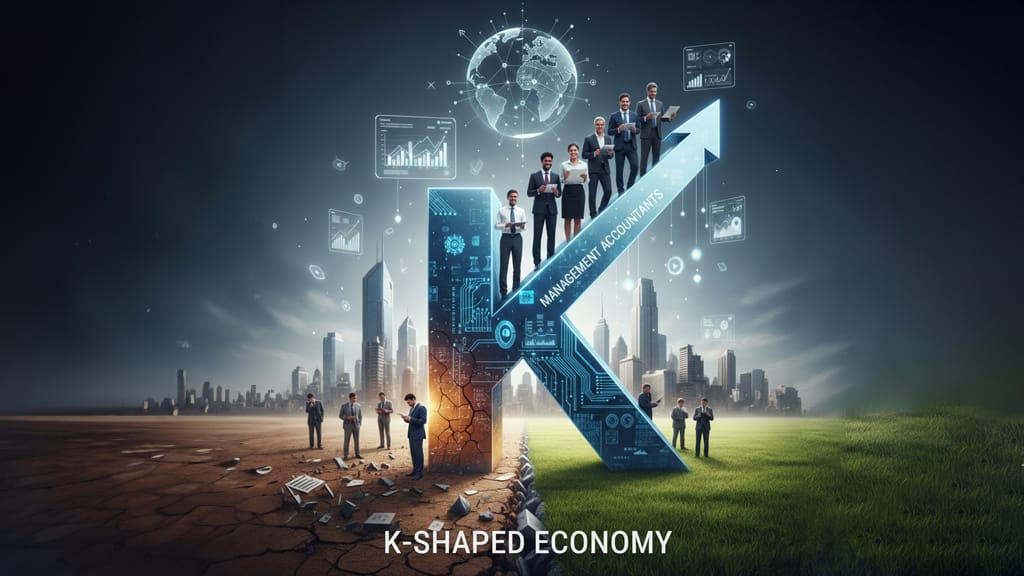
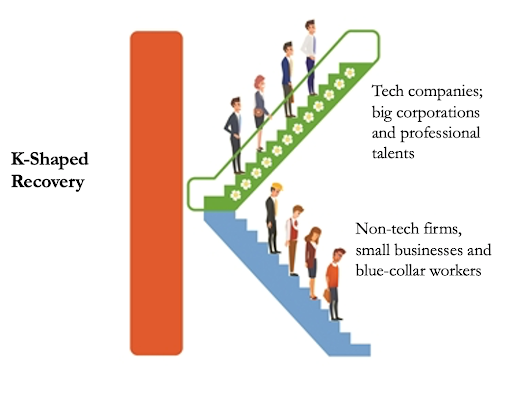
The K-shaped economy is a phenomenon in which the fortunes of the wealthy track steadily higher, while those on the lower end of the income spectrum gradually sink. Unfortunately, while AI does have the potential to one day help close the inequality gap, living standards will for the foreseeable future continue to fork.
This trend will significantly impact the costing models used by management accountants, who will encounter significant changes in cost structure and resource allocation. For example, the K-shaped economy will most likely see that traditional “direct labour” in both manufacturing and service organisations will be totally replaced by “indirect labour” provided by robotics and AI agents. Additionally, the K-shaped economy will impact strategic decision-making, risk management, performance measurement, and reporting. Management accountants will need to also develop tools for tracking the environmental and social impact of the K-shaped economy.
This article explores the impact of a K-shaped economy on management accounting, with examples illustrating these changes.
Characteristics of a K-Shaped Economy
The term ‘K-shaped economy’ emerged prominently during the COVID-19 pandemic to describe the divergent economic recovery experienced by different sectors and groups of people. Unlike a V-shaped recovery, where the economy bounces back quickly after a downturn, or a U-shaped recovery, where the rebound is more gradual, a K-shaped recovery indicates a split trajectory, where parts of the economy recover and grow while others continue to decline or stagnate, creating a more pronounced divide between economic winners and losers.
Today the latest ‘crisis’ is not a pandemic but the explosion in investment in artificial intelligence (AI). In a K-shaped economy, different sectors and demographics will experience vastly different economic outcomes in this latest ’crisis’. Some sectors see growth and prosperity, while others struggle to regain the economic outcomes they had in the pre-AI world. A key feature of a K-shaped economy is the widening gap between different socioeconomic groups. High-income individuals and industries that can adapt to new conditions, like technology, often prosper, whereas lower-income workers and industries reliant on physical presence suffer.
Impact of the Investment in AI on Wealth Generation and Wealth Distribution
AI has delivered more than a 7% uplift in household wealth for U.S. consumers. However, this “powerful boost” has mostly landed in the pockets of high-income Americans.
The “wealth effect” created by the blockbuster spending in AI (households feeling wealthier because the value of their assets is increasing and thus increasing their spending) will reinforce the K-shaped economy, most likely until 2035 (Edwards, 2026). In fact, the idea of this diverging economy was supported by research from the likes of Moody’s that observed that the economy is being almost exclusively driven by the sentiments of the “well-to-do” (Pringle, 2026).
It now is clear that the AI boom will reinforce the K-shaped economy for decades to come. In fact, in the long-run, AI may well end up being a driving force to bring those two groups a bit closer together, but in order to see that, one would need to see clear productivity gains at the lower end of the income spectrum. Such productivity gains at a low level (i.e., low-skilled jobs) will come through only when real wages increase, leading ultimately to improved living standards.
However, such unification of real wages may take more than five or 10 years, if it happens at all. Historically, technological disruptions do eventually bring things together through the wealth effect of investment and other macroeconomic factors. However, in the meantime, it is unlikely that AI will help with relieving the K-shaped economy. Industries such as technology, e-commerce, and financial services often thrive in a K-shaped recovery due to their adaptability and relevance in a changing world. Conversely, sectors like travel, hospitality, and traditional retail may lag due to decreased demand and operational challenges.
Echoes of the K-shaped economy can be traced back over decades: In America, the US Fed began monitoring the distribution of household wealth in Q3 2010 and reported that total wealth equalled $60.76 trillion. Of that, the top 0.1% owned $6.53 trillion, and the top 99% to 99.9% owned $10.75 trillion. By contrast, the bottom 50% shared only $330 billion (DFA, 2026).
Fast-forward to Q3 2025: The wealth of the bottom 50% has grown by 1,189% to $4.25 trillion—though still significantly behind the wealth held by the top 0.1% even some 15 years prior. The top 0.1% saw their wealth grow 281% to $24.89 trillion, nearly six times the wealth held by the bottom 50% combined. (DFA, 2026).
‘Hollowing out’ the middle-skill jobs
Economic modelling suggests that AI adoption across businesses is likely to be something of an “S-curve,” beginning slowly and then rapidly increasing before gradually levelling off. As per Oxford Economics’ modelling, there will never be a full integration of AI in businesses, as it cannot be used to replace physical trade jobs of a non-repetitive nature (repetitive jobs on a production floor are already done by industrial robots). The protection from AI for trade jobs (and indeed, the potential boon data centres represent for the likes of plumbers and electricians) does mean a “hollowing out” of certain roles will occur in the coming years (Fore, 2026).
The indications are that the economy in most countries will see lots of employment growth at both the lower end of the distribution and right at the top—but for middle-income jobs, there will most likely be a contraction in job growth. That is largely because those middle-skilled jobs are the ones where you can mostly substitute tasks away with something like AI. Companies need critical analyses, and managers need the ability to question things—such questioning tends to come at the top levels of the company. Middle management tends to be filled with people who are aspiring to the top jobs and currently just learning those top-level skills.
This dichotomy is confirmed by a report from the Penn Wharton Budget Model, which observed last year that AI adoption will plateau in the early 2030s as a result of declining opportunities to employ additional AI tools productively (Wharton, 2026).
The Impact of a K-Shaped Economy on Management Accounting
The emergence of a K-shaped economy, characterised by uneven recovery patterns across different sectors and demographics, presents new challenges and opportunities for management accounting. As companies navigate this complex economic landscape, management accountants play a crucial role in providing strategic insights and financial analysis to guide business decisions. Discussed below are some key areas in which the K-shaped economy will provide challenges to management accountants.
Changes in Cost Structure and Resource Allocation
Sector-Specific Cost Analysis: In a K-shaped economy post-AI introduction, sectors such as technology and e-commerce are expected to thrive, while others like hospitality and retail will struggle. Management accountants must, therefore, adapt their cost analysis techniques to account for these divergent trajectories. For example, a technology company experiencing rapid growth may require detailed cost analysis for scaling operations, including investments in infrastructure and staffing. Conversely, a struggling retail business may focus on cost-cutting measures and optimising resource allocations to maintain profitability.
Dynamic Budgeting and Forecasting: The uncertainty and variability inherent in a K-shaped economy necessitate more dynamic budgeting and forecasting practices. Even traditional flexible and rolling budgets will no longer suffice, as they cannot accommodate the rapid changes in demand and market conditions. Management accountants must go beyond budgeting and develop extremely dynamic budgeting models that allow for real-time adjustments. For instance, a company in the travel industry might implement budgets based on real-time forecasts to better anticipate changes in consumer behaviour and adjust financial plans accordingly.
Strategic Decision-Making and Risk Management
Scenario Planning: With different sectors experiencing varied recovery paths, scenario planning becomes a vital tool for management accountants. By analysing different economic scenarios, companies can better prepare for potential risks and opportunities. For example, a manufacturing company might explore scenarios where supply chain disruptions impact production costs, allowing management to develop contingency plans and mitigate risks.
Investment Decisions: A K-shaped economy influences investment strategies, as companies must carefully evaluate where to allocate resources for maximum return. Management accountants provide critical insights into these decisions by analysing financial data and market trends. A company in the financial services sector, for example, might prioritise investments in digital platforms and cybersecurity while recognising the growing demand for online services.
Performance Measurement and Reporting
Tailored Key Performance Indicators (KPIs): In a K-shaped economy, traditional KPIs may not fully capture the nuances of sector-specific performance. Management accountants must develop tailored KPIs that align with the company’s strategic objectives and reflect the unique challenges and opportunities of their industry. For instance, an e-commerce business might prioritise metrics related to website traffic, conversion rates, and customer acquisition costs to better understand and optimise their digital sales channels. Meanwhile, a hospitality company might focus on metrics such as occupancy rates, average daily rates, and customer satisfaction scores to gauge operational efficiency and customer experience.
Enhanced Financial Reporting: In a K-shaped economy, stakeholders demand more detailed and transparent financial reporting to understand how businesses are navigating economic challenges. Management accountants play a crucial role in enhancing financial reports with qualitative insights and forward-looking information. For example, a company in the retail sector might include detailed analyses of changing consumer behaviour and its impact on sales forecasts in their financial disclosures.
Tracking the Environmental Impact of the K-shaped Economy
The concept of a K-shaped economy, where different sectors and groups experience varied recovery trajectories, has far-reaching implications beyond financial markets and societal structures. It also significantly impacts the environment, influencing everything from carbon emissions to resource consumption.
Increased Resource Demand in Growing Sectors: In sectors experiencing growth, such as technology and e-commerce, there is often an increased demand for resources. For instance, the surge in e-commerce has led to a rise in packaging waste and heightened energy consumption due to expanded logistics operations. Companies like Amazon have experienced exponential growth, which, while economically beneficial, also leads to increased environmental footprints through more significant carbon emissions from transportation and packaging waste.
Reduced Environmental Pressure from Declining Sectors: Conversely, sectors facing declines, such as travel and hospitality, have seen a temporary reduction in their environmental impact. During the COVID-19 pandemic, reduced air travel led to a noticeable decline in carbon emissions and air pollution. The grounding of flights and reduced hotel operations contributed to a temporary environmental reprieve, highlighting the significant impact these industries have on the environment. Similarly, if the K-shaped economy results in a significant amount of the workforce struggling to make ends meet, then air travel and holidays overseas will also have reduced demand.
Opportunities for Green Investment: The K-shaped economy presents opportunities for governments and businesses to invest in green technology and infrastructure, potentially leading to significant environmental benefits. Governments can implement policies that encourage the development of sustainable industries, such as renewable energy and public transportation, thereby aligning economic recovery efforts with environmental goals. Management accountants will be at the forefront of such green investment decisions.
Tracking the Social Impact of the K-shaped Economy
Changes in Consumer Behaviour: As some consumers become more environmentally conscious, influenced in part by the economic disparities highlighted by the K-shaped recovery, there is a growing demand for sustainable products and practices. This trend is evident in the increased popularity of electric vehicles (EVs) and renewable energy solutions. Companies in the green technology sector, such as Tesla and various solar energy providers, have benefited from this shift, aligning economic growth with positive environmental outcomes.
Challenges in Promoting Sustainability: However, the economic challenges faced by lower-income groups can hinder the adoption of sustainable practices. Individuals and businesses struggling financially may prioritize short-term economic survival over long-term environmental considerations. For example, a small business facing financial constraints may opt for cheaper, less environmentally friendly materials or practices to cut costs.
Conclusion
The K-shaped economy presents both challenges and opportunities for management accountants as they support businesses in adapting to a rapidly changing environment. By leveraging dynamic budgeting, scenario planning, tailored KPIs, and enhanced financial reporting, management accountants can provide the strategic insights necessary to navigate these complex times. As companies continue to face divergent recovery paths, the role of management accounting becomes increasingly vital in ensuring informed decision-making and sustainable growth. Through their expertise, management accountants help businesses remain agile and resilient amidst the uncertainties of a K-shaped economic landscape.
The K-shaped economy also has complex implications for the environment, showcasing both challenges and opportunities. While growing sectors may contribute to increased resource consumption and emissions, they also have the potential to lead the way in adopting sustainable practices. Meanwhile, declining sectors may temporarily reduce their environmental impact but face challenges in maintaining sustainability as they recover.
To deal with these changes, businesses, consumers, and policymakers must work together to promote and put into action environmentally friendly practices. By aligning economic recovery efforts with environmental sustainability, societies can work towards a more resilient and equitable future that benefits both the economy and the planet. Through strategic investments, inclusive policies, and increased environmental awareness, the management accountant can not only provide decision support information to management to negotiate a K-shaped economy but also serve as a catalyst for meaningful environmental progress.
References:
DFA (2026), Distribution of Household Wealth in the U.S. since 1989, Distributional Financial Accounts, Board of Governors of the Federal Reserve, https://www.federalreserve.gov/releases/z1/dataviz/dfa/distribute/chart/#range:2010.3,2025.3;quarter:144;series
Edwards, Jim (2026), “The $600 billion wave of AI ‘capex’ growth boosting stocks is about to slow down, analysts warn,” Fortune, January 29. https://fortune.com/2026/01/29/ai-capex-growth-tech-stocks-slow-down/
Fore, Preston (2026), “Nvidia CEO Jensen Huang says ‘a lot’ of six-figure jobs in plumbing and construction are about to be unlocked because someone needs to build all these new AI centres,” Fortune, January 21. https://fortune.com/2026/01/21/nvidia-ceo-jensen-huang-skilled-trade-job-boom-ai-construction-six-figure-salaries-plumbing-construction-electricians/
Pringle, Eleanor (2026), “Get used to the K-shaped economy. It’s likely here until 2035, thanks to AI’s outsize benefit for the wealthy’,” Fortune, January 29, https://fortune.com/2026/01/29/k-shape-economy-reinforced-ai-wealth-effect/
Pringle, Eleanor (2026), “The economy is reliant on the ‘fortunes of the well-to-do’ says Moody’s—if the ultra-rich get nervy that means recession,” Fortune, September 17, https://fortune.com/2025/09/17/economy-reliant-on-wealthy-consumer-moodys-consumer-spending/
Wharton (2026), “The Projected Impact of Generative AI on Future Productivity Growth”, University of Pennsylvania, September 8. https://budgetmodel.wharton.upenn.edu/issues/2025/9/8/projected-impact-of-generative-ai-on-future-productivity-growth