

A Journey from the Bottom of a Well to a World of Strategic Possibilities
The ‘Well’ We Mistake for the ‘World’
“We see the world, not as it is, but as we are— or as we are conditioned to see it.” Stephen R. Covey
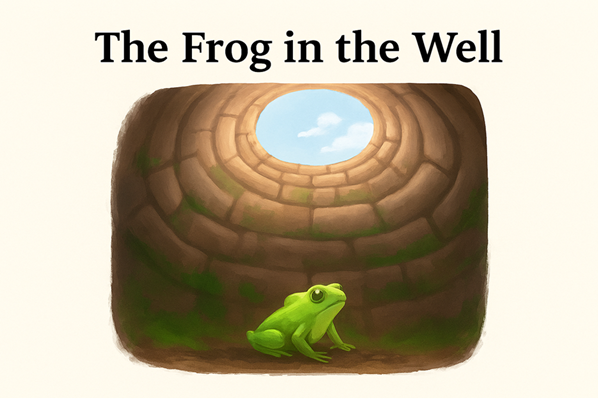
There is a parable told in various Eastern traditions about a small frog who lived at the bottom of a deep stone well. To the frog, the well was not just home but the entire universe. The sky was a small circular patch of blue. Reality was defined by what lay within those walls. One morning, a bird perched at the edge of the well and described a vast outer world filled with oceans, mountains and endless horizons. The frog dismissed the bird with certainty. His experience had taught him that nothing existed beyond the stone walls of the well. Why should he believe otherwise
The bird persisted until the frog climbed onto its back. As they ascended above the rim of the well, the frog saw a world far greater than he had ever imagined. The assumptions he held so tightly dissolved. His worldview transformed.
For many years, I too lived at the bottom of a well. I had a successful financial accounting, auditing and taxation practice with more than one hundred employees. I served multinational clients. My seminars regularly attracted audiences of over fifteen hundred participants. By all conventional markers, I had reached the pinnacle of professional success. Yet my world was defined by the familiar boundaries of compliance, statutory reporting and historical financial analysis.
Financial accounting had become my well. And like the frog, I believed it was the only world that mattered. Like countless accountants who begin their careers in compliance and reporting, I lived within a well that was comfortable, structured, and financially rewarding.
From the bottom of that well, the sky above seemed wide enough. I believed I understood the profession and that my world was complete. I had mastered the “Internal”- the debits, the credits, the tax codes, and the statutory requirements. I was a master of my well.
Epictetus once observed that it is impossible for a person to learn what he thinks he already knows (Long, 1925). My comfort had quietly become a constraint. I could not see how rapidly the world of finance was changing outside the walls of my well. I was blind to the strategic shifts, the technological disruptions, and the global volatility that would soon render my “mastery” obsolete.
When the Bird Appears
“The real voyage of discovery consists not in seeking new landscapes but in having new eyes.” Proust (1923)
My bird arrived unexpectedly in the form of the CMA program, introduced to India for the first time by Professor Janek Ratnatunga. Until that moment, my understanding of the accounting profession was narrowly focused on financial reporting, taxation and audit. The idea that accountants could become strategic partners in decision making was unfamiliar.
Professor Janek spoke of a broader world. He described management accounting as the language of strategy, value creation and decision science. He explained that organisations thrive not merely through compliance but through intelligent navigation of uncertainty. He talked about customers, competitors, technology, risk and external forces that shape the future.
At first, I resisted. The well was comfortable. But something in his conviction unsettled my assumptions. I decided to climb far enough to look over the rim. I climbed onto the back of that bird. I enrolled in the CMA program.
What I saw changed the direction of my life.
The CMA program revealed a world where accountants could influence the trajectory of organisations, guide strategic choices and interpret complexity. It shifted my identity from someone who recorded history to someone who helped shape it. It was not simply new knowledge. It was a new way of seeing.
A New Understanding of Value
“The greatest danger in turbulence is not the turbulence. It is to act with yesterday’s logic. “Peter Drucker (1980)
The CMA curriculum required that I abandon the logic of the well and embrace a wider horizon. I learned that strategy is shaped not merely by internal numbers but by the context in which those numbers exist. Financial reports describe what has happened. Management accounting anticipates what may happen and what must be done.
This shift in perspective was profound. Profit and loss statements reveal outcomes. They do not reveal the competitive forces behind those outcomes. Balance sheets show positions. They do not show possibilities. Traditional accounting illuminates the past. CMA illuminates the future.
As Mintzberg notes, strategy is not a plan but a perspective (Mintzberg 1994). The CMA program gave me the tools to develop that perspective.
The Ice Cutter and the Lesson of Extinction
“It is not the strongest species that survives, nor the most intelligent, but the one most responsive to change. “Prof Leon Megginson (1963)
In the nineteenth century, thousands of workers made a living cutting blocks of ice from frozen lakes. These ice cutters were skilled professionals. Their trade was essential. The arrival of artificial refrigeration rendered the profession obsolete in less than a decade.
The ice cutter did nothing wrong. The environment changed. The CMA Program transformed the arc of my professional life. It was not just an education; it was a revelation. I realized that for decades, I had been an “Ice Cutter” in an industry that was rapidly inventing the refrigerator
Today, much of financial accounting faces a similar risk. Artificial intelligence, automation and blockchain technologies can now perform compliance tasks with speed and accuracy that surpass human capability. If accountants remain focused solely on recording transactions, they may become the ice cutters of the twenty-first century.
This does not diminish the importance of financial accounting. It highlights the urgent need to evolve beyond it.
The CMA program is designed precisely for that evolution.
The Titanic and the Illusion of Safety
“If the Titanic had a management accountant, it would not have sunk” Prof ;Janek Ratnatunga (1997)
The distinction between a Financial Accountant and a Management Accountant is often misunderstood. Many believe they are two sides of the same coin. Prof Ratnatunga explains it using the tragedy of the Titanic.
The Titanic offers a powerful metaphor for the difference between financial and management accounting.
Imagine the Titanic sailing across the Atlantic. The Financial Accountant will stand at the back of the ship (the stern) looking at the wake – the white foam trail left behind by the ship. His job was to record where the ship had been. He would write in his logbook: “We travelled 500 miles today. The coal consumption was X tons. The weather was cold.”
His information was accurate. It was compliant. It was “true and fair.” But it was entirely historical. He was looking in the rear-view mirror.
Now, where was the Management Accountant? He should have been at the front of the ship (the bow), standing next to the Captain. He would be holding a pair of high-powered binoculars. His job was not to record where the ship had been, but to scan the horizon for what was coming. His role was to say, “Captain, there is an iceberg ahead. If we do not change course by 30 degrees, we will hit it.”
Modern organisations face icebergs far less visible but far more complex than those in the North Atlantic. Without the forward-looking intelligence that management accountants provide, even strong companies can drift into danger.
Compliance keeps the ship legal.
Management accounting keeps the ship alive.
The Titanic sailed with fourteen financial accountants. It sailed, however, with no one performing the role of a management accountant. It was guided by history rather than foresight.
The ship didn’t sink because the books weren’t balanced. It sank because no one was looking forward with the right analytical tools to spot the danger.
This is the “Titanic Syndrome” that plagues many modern businesses. They are full of professionals focused on Conformance:
- Legal Compliance
- Audited Financial Statements
- Stock Market Disclosures
- Corporate Affairs Requirements
These are essential; they keep the ship legal. But conformance is a “short-term focus.” It looks at Net Profit, EBIT, and ROI based on past actions.
The CMA program teaches you to focus on Performance:
- Value Creation
- Strategic Management
- Risk Management
- Change Management.
A financial accountant provides “trailing indicators”—data about what has already happened, like how many people ate in a restaurant last week. A management accountant looks for “leading indicators” – interviewing customers to find out why they came, what they want next, and how to grow the business
In the turbulence of the global economy, looking backward is fatal. You cannot steer a ship – or a global career – by staring at the wake. You need the binoculars.
The Tools of the Navigator: The CMA Curriculum
“If you know the enemy and know yourself, you need not fear the result of a hundred battles.” Sun Tzu (1963)
How exactly does the CMA program equip you to leave the well? It does so through two intensive, Master’s-level modules that function as your “wings.” These are not merely academic subjects; they are practical toolkits for survival in the modern boardroom.
Module 1: Strategic Cost Management (The Engine)
This module answers the question: How do we measure and manage our costs to create value? We drill down into the four pillars of modern competition: Quality, Cost, Time, and Innovation. You learn how to measure the “Cost of Quality” (prevention vs. failure costs) and how to use “Just-In-Time” (JIT) philosophies to eliminate waste and speed up cycle times.
As Prof Janek explains in his recent article on “Car Brands in Crisis: The Battle Between Established Giants and Chinese EVs” – “the four main challenges facing both manufacturing and service industries (that management accountants are well aware of): i.e. Quality, Cost, Time and Innovation, need to be at the forefront of strategic decision making if established car brands, predominantly from Europe, Japan, and the United States, have any hope of overcoming the multiple challenges brought about by Chinese EV manufacturers.”
It moves beyond the simplistic “slash and burn” cost-cutting mentality to “Strategic Attention Directing.”
- Life Cycle Costing & Target Costing: Traditional accounting looks at the cost of production in isolation. The CMA teaches Life Cycle Costing, which accounts for the cost of a product from its “cradle” (R&D) to its “grave” (disposal/recycling). We also teach Target Costing, a method used by companies like Toyota, where the market price determines the allowable cost, forcing innovation in the design phase.
- Activity-Based Management (ABM): Most companies allocate overheads arbitrarily, leading to distorted profitability analysis. We teach Activity-Based Costing (ABC), which assigns costs to the specific activities that consume resources. This allows you to see which customers, products, or channels are actually destroying value, even if they appear profitable on the surface.
- Benchmarking: This is the “Bird” from our opening parable. As long as an organization is internally focused, comparing this year’s results only to last year’s results, it is a frog in a well. Benchmarking forces you to look outside—comparing your processes to the world’s best practices. It is the systematic search for the “superior performance” that exists outside your well.
Module 2: Strategic Business Analysis (The Compass)
This module answers the question: Are we going to do well or badly with our strategies? It focuses on “Strategic Problem Solving.”
- Strategic Marketing & Pricing: Accountants often leave pricing to the sales team. The CMA teaches that pricing is a financial decision. We explore Skimming vs. Penetration pricing, the financial implications of the 4Ps of Marketing (Product, Price, Place, Promotion), and how to budget for brand equity.
- Risk Management: In a volatile world, risk is not just about insurance; it is about survival. We teach Enterprise Risk Management (ERM) frameworks, helping you to identify strategic, operational, and financial risks before they become icebergs.
- Shareholder Value Analysis (SVA): We move beyond accounting profit to Economic Value Added (EVA). You will learn to calculate the true cost of capital and determine if a strategy is actually generating wealth for shareholders or merely consuming capital.
- The Strategic Audit: Finally, we teach the Strategic Audit. This is a high-level governance tool that ensures the organization’s strategy is aligned with its resources and the external environment. It answers the ultimate question: Is our business model sustainable?
My Own Transformation – A Case Study
“What we know is a drop. What we do not know is an ocean.” – Isaac Newton (1727)
The proof of this methodology is not in the textbooks, but in the results. I want to share my own “Case Study” of how the CMA principles transformed my career.
After completing the program with Professor Janek, I did not just return to my practice with a new certificate on the wall. I fundamentally changed how I operated. I took on a role as CFO for a company that was in deep financial trouble.
The Situation: The company was bleeding cash. It had five revenue-earning departments across Australia and New Zealand. The Board was confused; sales were reasonable, but the bottom line was red. The existing financial reports—produced by a basic MYOB system—were “compliant” but useless. They showed that we were losing money, but not where or why.
The CMA Intervention: I applied the Strategic Cost Management tools I had learned.
- System Overhaul: We moved from a basic ledger system to NetSuite, a cloud-based ERP that allowed for real-time data analysis.
- Activity-Based Costing (ABC): We stopped allocating overheads based on revenue. We traced costs to specific activities.
- The Discovery: The ABC analysis revealed that two specific departments were consuming 80% of the support resources while generating only 20% of the margin. The “star” products were actually subsidizing the “dogs.”
The Result:
Armed with this “Strategic Business Analysis,” I presented a restructuring plan to the Board. We didn’t just cut costs blindly; we surgically removed the value-destroying activities. Within three months, we provided the Board with accurate, department-wise, location-wise profitability reports.
We turned the company around in six months. A few years later, that business was sold for millions. The Managing Director credited our management accounting reporting with the turnaround.
That is the power of the CMA. It allows you to say, “I am an Accountant, and this is my superpower.”
2026 and Beyond – A World Becoming More Volatile
“The future is disorder… It is the best possible time to be alive.” – Tom Stoppard (1993)
Why is this qualification more critical now than ever before? As we look toward 2026, we are entering an era of “Hyper-Turbulence.”
The global landscape is being reshaped by three seismic forces:
- Geopolitical Fragmentation: Global supply chains are fracturing. The era of seamless globalization is ending, replaced by tariffs, trade wars, and “friend-shoring.” A traditional accountant sees a tariff as a cost entry. A CMA sees it as a signal to redesign the supply chain and re-evaluate the “Make or Buy” decision using Life Cycle Costing.
- The AI Revolution: Generative AI is advancing faster than regulation. It is compressing decision cycles. In 2026, a quarterly report is too slow. Organizations need real-time, predictive analytics. The CMA trains you to be the “human in the loop”—the strategist who interprets the AI’s output and applies ethical, strategic judgment.
- Economic Volatility: Interest rates, currency fluctuations, and inflation are no longer stable variables. They are dynamic risks. The “Iceberg” is moving faster. Organizations that rely on static budgets and historical reporting will be blindsided. They need Antifragile thinkers—professionals who can design systems that actually benefit from volatility.
As Nassim Nicholas Taleb argues, systems that learn to benefit from uncertainty become antifragile rather than merely resilient. Traditional accounting is built for stability. The CMA prepares you for turbulence.
The CMA Framework: SCM and SBA as New Lenses
“What gets measured gets managed.” Peter Drucker (1954)
The CMA program introduced two intellectual frameworks that transformed the way I interpreted the business world.
Strategic Cost Management (SCM) taught me that cost is not merely a number but a reflection of processes, activities and decisions. SCM shifted my focus from cost cutting to value creation. It taught me to analyse the cost structure across the value chain and to evaluate where quality, time or innovation drive competitive advantage.
Strategic Business Analysis (SBA) provided a framework for understanding whether strategies would succeed or fail. SBA integrates marketing, risk management, financial analysis and competitive intelligence. It emphasises scenario planning, strategic audits and stakeholder value.
These frameworks did not increase the number of things I looked at. They increased the intelligence with which I looked at them.
Becoming a Creativepreneur
“Innovation distinguishes between a leader and a follower.” Steve Jobs (2003)
There is a stereotype that accountants are conservative, predictable and risk averse. Yet the future of the profession belongs to those who can combine financial discipline with creative thinking.
A Creativepreneur is not content to satisfy existing customer needs. A Creativepreneur anticipates needs, shapes markets and creates value. CMA nurtures this mindset by teaching strategic innovation, scenario thinking and value-driven analysis.
Management accounting is not about counting the beans. It is about growing them.
The World Beyond the Well: Global Opportunities
“An investment in knowledge pays the best interest.” Benjamin Franklin (1758)
The frog who stays in the well knows only the other frogs. The bird flies across continents.
CMA ANZ today is a global professional body with members across more than one hundred countries. The qualification is recognised by multinational corporations, government agencies and educational institutions. The CMA mindset equips professionals to operate in diverse cultural, regulatory and economic environments.
Whether through face-to-face intensives or global online cohorts, the CMA program connects professionals into a network of strategists, leaders and value creators.
It is not just a qualification. It is a passport to the world.
Toward a Larger Horizon
“You must live in the present, launch yourself on every wave, find your eternity in each moment.” Henry Thoreau (1851)
The frog in the well believed he understood the world. His world changed only when he allowed himself to rise above its walls. The frog-in-the-well parable is not merely a story. It is a mirror. It is a reminder of how easy it is to shrink our world to the size of what is familiar. It is a warning that comfort is often the precursor to obsolescence
The CMA program was the bird that lifted me out of my well. It expanded my horizon, deepened my thinking and transformed my career. It allowed me to understand not just the numbers but the forces behind the numbers. It prepared me to navigate not only stability but volatility.
The CMA program was the bird that lifted me beyond the boundaries I had unknowingly imposed on myself. It allowed me to see a world of strategy, possibility, and leadership. It gave me a passport to a global career that spans over 100 countries, allowing me to teach and lead in Dubai, Japan, Thailand, and beyond.
For thousands of professionals around the world, CMA has done the same.
The question each of us must answer is simple.
Will we remain inside the well we know, or will we rise above it and embrace the world that awaits. Will you continue to live within the limits of the well?
Will you be content with being an “Ice Cutter” in the age of the refrigerator, or a “Rear-View” accountant on the Titanic? Or, will you climb onto the bird (THE CMA PROGRAM)?
Will you pick up the binoculars of Strategic Management Accounting and embrace the horizon that awaits?
References
Churchill, W 1948, The Wit and Wisdom of Winston Churchill, Michael Joseph, London.
Drucker, P 1954, The Practice of Management, Harper and Row, New York.
Drucker, P 1980, Managing in Turbulent Times, Harper and Row, New York.
Emerson, RW 1844, Essays: Second Series, James Munroe, Boston.
Long, G 1925, The Discourses of Epictetus, trans. George Bell and Sons, London.
Franklin, B 1758, The Way to Wealth, B Franklin and D Hall, Philadelphia.
Jobs, S 2003, Interview, BusinessWeek Magazine.
Kaplan, R & Norton, D 1992, The Balanced Scorecard: Measures that Drive Performance, Harvard Business Review, Boston.
Megginson, L 1963, Lessons from Europe for American Business, Southwestern Social Science Quarterly, Louisiana.
Mintzberg, H 1994, The Rise and Fall of Strategic Planning, The Free Press, New York.
Proust, M 1923, In Search of Lost Time, Grasset, Paris.
Seneca 65 AD, Letters from a Stoic, Penguin Classics, London.
Sun Tzu 1963, The Art of War, trans. Clarendon Press, Oxford.
Taleb, NN 2012, Antifragile: Things That Gain from Disorder, Random House, New York.
Thoreau, HD 1851, Journal, Houghton Mifflin, New York.