



Over the past 100 years, we’ve witnessed transformations more radical than those of many centuries before. Each decade of the last century has reshaped how we live, work, and think—often in ways unimaginable to even the most daring futurists. While these shifts have vastly improved human life, they’ve also placed unprecedented strain on our planet. This article explores each decade’s socio-economic context, the rise of key management ideas, and how finance and accounting evolved alongside.
1920s – The Efficiency Era: Foundations of Modern Management
The 1920s marked the peak of the Second Industrial Revolution. Rapid industrialisation, urban growth, and post–WWI recovery fuelled mass production and consumer demand. Factories scaled up to serve a booming middle class.
Frederick Taylor’s Scientific Management Principles transformed work into a science of efficiency. Time-and-motion studies broke tasks into repeatable units, emphasising standardisation, specialisation, and output over intuition. Workforces became components in a larger production machine.
These ideas revolutionised accounting. Firms needed granular data to track productivity, allocate overheads, and manage capital investments. This gave rise to standard costing, variance analysis, and capital budgeting—foundational tools for modern management accounting and strategic decision-making.
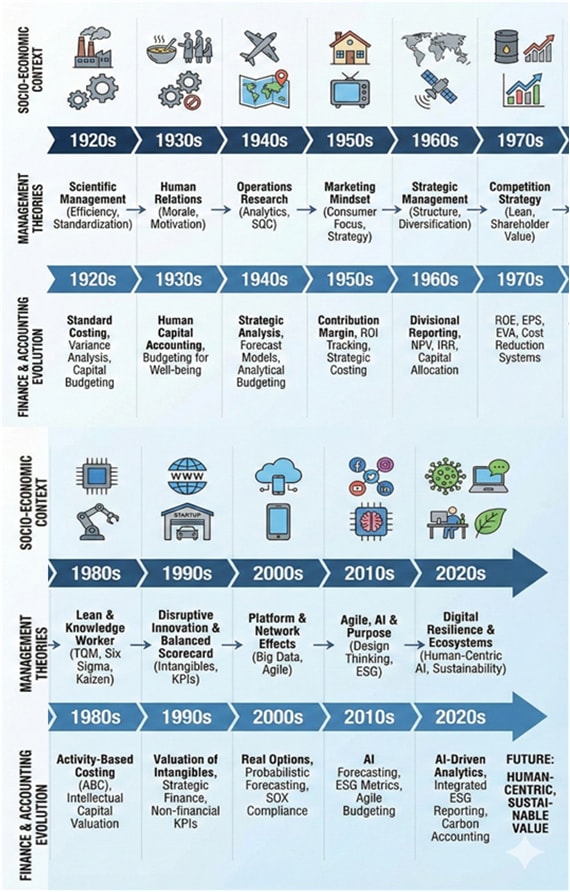
Decoding a Century: Management & Finance Transformation Timeline
1930s – The Human Factor Decade
The 1930s were shaped by the Great Depression—marked by mass unemployment, corporate failures, and widespread uncertainty. Amid the crisis, governments began regulating labour and workplace standards to stabilise economies.
Management thinking took a human-centred turn with Elton Mayo’s Hawthorne Studies, revealing that productivity was not just about physical conditions or wages—but also about morale, recognition, and belonging. The Human Relations Movement took root, introducing concepts like motivation, informal groups, and participative leadership.
Financial practices followed suit: budgets began accounting for training, morale, turnover, and supervision costs. This decade sowed the seeds of human capital accounting, where employee well-being and organisational culture were no longer soft concerns—but measurable drivers of sustainable profitability and performance.
1940s – The Age of Analytics and Wartime Precision
The 1940s were shaped by World War II and its aftermath. Entire economies were mobilised for the war effort, requiring large-scale planning, logistical precision, and efficient resource management. Post-war reconstruction accelerated technological advances and systems thinking.
Operations Research (OR) emerged, applying statistics, mathematics, and decision science to solve complex problems. Statistical Quality Control (SQC), popularised by Shewhart and Deming, emphasised data over intuition. This decade marked the shift towards analytics, performance metrics, and system optimisation.
Accounting evolved from record-keeping to strategic analysis. Tools like standard costing, variance analysis, and analytical budgeting supported OR-led efficiency. Finance professionals became strategic partners, aiding capital planning and resource optimisation using forecast models and quantitative tools.
1950s – The Age of Marketing Mindset and Strategic Spending
The post-war boom of the 1950s brought rising incomes, suburban growth, and consumerism. With televisions and mass media reaching millions, businesses began focusing less on production and more on understanding consumer desires, brand loyalty, and market differentiation.
Marketing emerged as a strategic discipline. Thought leaders like Peter Drucker, Theodore Levitt and Philip Kotler emphasised that the purpose of a business is to create and keep customers. Concepts like segmentation, positioning, and competitive advantage took root. Firms invested in advertising, R&D, and customer-centric innovation.
Finance adapted to support marketing strategy—tracking customer acquisition cost, advertising ROI, and product profitability. Tools like contribution margin analysis, break-even models, and strategic costing became essential to align budgeting with market-driven decision-making.
1960s – The Strategy Era: Aligning Structure with Vision
The 1960s saw rising globalisation, cold war tensions, and rapid technological advances. Corporations expanded into conglomerates, and global markets became more interconnected. With increasing complexity, firms needed clear direction and better coordination between growth, risk, and performance.
Strategic management emerged as a discipline. Thinkers like Alfred Chandler and Igor Ansoff highlighted the need to align organisational structure with long-term strategy. Strategic planning, diversification, and portfolio management gained traction, with corporate HQs guiding multi-divisional operations and capital allocation.
Divisional reporting, ROI, and investment appraisal tools like NPV and IRR became critical. Finance evolved to support strategic decision-making, capital budgeting, and performance evaluation in diversified business environments.
1970s – The Age of Competition and Capital Efficiency
The 1970s brought stagflation, oil crises, and rising global competition—especially from Japan. Businesses faced inflationary pressure, declining productivity, and unpredictable markets, forcing a shift toward profitability, agility, and capital discipline.
Michael Porter’s Five Forces framework reframed competitive strategy. Milton Friedman’s view of shareholder primacy gained momentum, prioritising investor returns. Lean production, Just-In-Time (JIT), and waste reduction—pioneered in Japan—were widely adopted. Strategy became more combative, efficiency-focused, and market-driven.
Finance emphasised capital efficiency, ROE, TSR, and EPS. EVA (Economic Value Added) began gaining traction. Accounting evolved to support lean operations, performance measurement, and shareholder-value creation. Cost systems adapted to inflationary realities and competitive pressures.
1980s – The Rise of Lean Thinking and the Knowledge Worker
Deregulation, globalisation, and technology defined the 1980s. Japan’s industrial efficiency challenged the West, while computing and automation shifted the focus from manual labour to knowledge work.
Toyota’s Lean system, built on Kaizen and Just-in-Time (JIT), became a global model. Western firms adopted Total Quality Management (TQM) and Six Sigma. Peter Drucker introduced the “knowledge worker” concept, recognising intellectual labour as a key economic driver. People and process became central to productivity and innovation.
Activity-Based Costing (ABC) emerged to more accurately trace costs. Investment in training and R&D was seen as strategic, not just operational. Human and intellectual capital gained attention in valuation, influencing long-term planning and reporting.
1990s – The Digital Dawn and Shareholder Value Revolution
The 1990s saw the rise of the internet, globalisation, and deregulation. Startups disrupted established firms, while intangible assets like brand, innovation, and customer loyalty became key to competitiveness.
Clayton Christensen’s theory of Disruptive Innovation explained how small players could overtake giants. Kaplan and Norton’s Balanced Scorecard introduced non-financial KPIs—like customer satisfaction and innovation—into strategy. Knowledge management also gained importance.
Traditional metrics could not capture intangible value. The Balanced Scorecard helped finance teams include forward-looking and qualitative performance drivers. Valuation models began factoring in intangibles, making finance more strategic in managing brand equity, customer retention, and innovation.
2000s – The Connected Enterprise and Corporate Scandals Era
The 2000s saw a further shift towards digital operations and globalisation. Internet expansion, platform businesses, and data became strategic drivers. Tech giants like Amazon and Google reshaped industries. The 2008 financial crisis highlighted the need for stronger risk and transparency measures.
Platform-based thinking and network effects redefined value creation. Big data and early machine learning supported predictive analytics, demand forecasting, and personalisation. Global supply chains and lean digitisation improved agility and efficiency.
Finance adapted to subscription models, data monetisation, and evolving revenue recognition standards. Tools like real options and probabilistic forecasting grew popular. Post-crisis, SOX regulations brought tighter controls, while risk management and financial reporting saw major upgrades.
2010s – AI, Agility, and Purpose
Smartphones, cloud computing, and social media redefined connectivity and created vast data ecosystems. Agile startups disrupted industries, while global challenges—like inequality, climate change, and data privacy—pushed businesses towards social responsibility.
Agile, lean startup methods and design thinking became mainstream. AI and machine learning enhanced decision-making and customer engagement. Ethical leadership and purpose-driven models gained traction, with leaders advocating empathy, inclusion, and long-term impact.
Finance embraced AI for forecasting, fraud detection, and anomaly spotting. ESG metrics rose in importance, with investors demanding sustainability. Agile budgeting, rolling forecasts, and scenario planning became essential. CFOs shifted towards strategic, ethical, and impact-aligned roles.
2020s – The Digital Disruption and Data Awakening Decade
The 2020s have been shaped by a cascade of global disruptions—from the COVID-19 pandemic to geopolitical shocks and climate emergencies. These accelerated digital transformations across every industry. Remote work, digital health, and online education redefined daily life. Data became the world’s most valuable resource, while concerns around misinformation, cybersecurity, and sustainability took centre stage. The decade also saw the rise of Gen Z as workers and consumers, demanding transparency, inclusion, and digital-first engagement.
Leadership models evolved towards resilience, empathy, and adaptability. “Digital-first” became the strategic default. Technologies like generative AI, blockchain, and the metaverse began reshaping customer experience and business operations. Firms embraced data democratisation, low-code platforms, and real-time decisioning. The pandemic normalised agile planning, hybrid teams, and decentralised innovation. ESG (Environmental, Social, Governance) moved from compliance to core strategy, and stakeholder capitalism gained traction.
CFOs led digital finance transformation—embedding automation, AI, and real-time analytics into core workflows. Integrated ESG and sustainability reporting became critical to investor relations. Finance teams adopted scenario-based planning, rolling forecasts, and carbon accounting. Accounting standards continue to evolve for digital assets, subscription revenue, and environmental liabilities. The function’s role expanded beyond stewardship into guiding long-term, purpose-aligned value creation.
Final Thought
To lead the future, businesses must evolve into ecosystems of impact—where tech drives progress, ethics set the compass, sustainability anchors decisions, and people stay at the heart. The next era of management won’t just be about getting smarter—it will be about getting more human.
To build this future, three pillars must guide our transformation. First, technology must serve as an enabler, not a replacement—tools like AI and data should empower decision-making, not dictate it. Second, sustainability and ethics must be embedded into strategy, not bolted on. And third, the human factor must be elevated, valuing empathy, emotional intelligence, and authentic connection as core drivers of innovation and impact.

As we stand on the brink of an era defined by seamless man–machine integration, let us not forget the essence of what makes us human. The future must not be a world where warmth is replaced by emojis or where conversations end with an algorithm. It must be a world where sustainability guides our progress, where ethics ground our innovations, and where technology empowers, not replaces, genuine connection.
In this dream future, we will meet eye to eye, not screen to screen; speak our own emotions with our own words, not AI-generated text; and end each day not with a tap to “log off”, but with a warm hug and the promise of tomorrow.
Mr. Kapila Dodamgoda, BEng. FCMA, is the ICMA(ANZ) Regional Director for Sri Lanka