

“The least thing precisely, the gentlest thing, the lightest thing, a lizard’s rustling, a breath, a whisk, an eye glance: little maketh up the best happiness.” Nietzsche (1885)
Inspired by, and dedicated to, little Aarav Christopher Sharma
A Flight Away from Home
I am writing this on a flight from Melbourne to Bangkok, and for the next month I will be in Jakarta and then in Bangkok, conducting the CMA Program. I have done this several times this year and I enjoy it. What is different this time is who I am leaving behind.
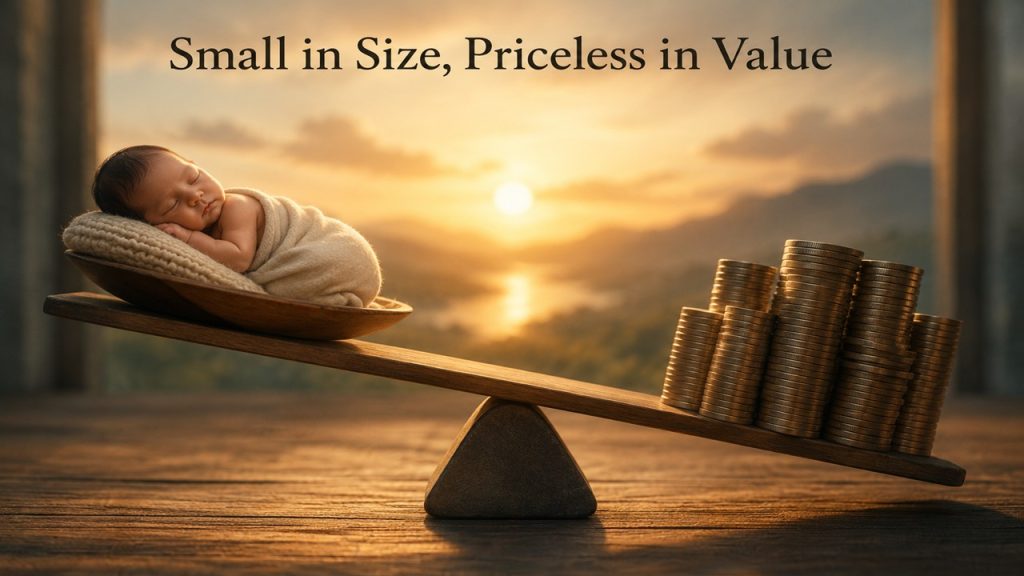
My grandson Ari has been in the world for just a week. He cannot say my name, though after seeing him every day for a week my heart insists that he will remember I was there. During that week when he held my finger in his tiny hand, he inspired me to write this article: Small in Size, Priceless in Value.
Two weeks ago, I spent a lot of money to fly home to Melbourne to spend just over a week with him. I know the exact figure. It went onto my bank statement and is sitting in a system somewhere that will keep it for seven years. The value I received from this trip has no number attached to it at all.
I paid a similar price over two decades ago and knew, while I was paying it, that the money was not the point. Different country, different currency, different decade, and nothing to do with a baby. On paper the two have nothing in common. However, they were the same equation, and I will come back to that story later, because it is the more useful of the two and because it explains why I am on this aircraft at all. The principle did not move an inch over two decades, and it has not moved over centuries either. It is the oldest lesson in business, and it turns up in a dozen places across the CMA Program without anyone ever calling it by its name.
The Only Number on the Page
We have all opened a bill and felt that small flinch. The plumber. The school fees. The insurance renewals and the energy bills that keep rising every year. We grumble, and the grumbling is always about the cost.
What the grumbling forgets is the roof that no longer leaks, the education, the warmth on a cold winter night, and the reason you did not lie awake worrying, which is that you were insured. All of that is real, and most often it is worth many times the figure printed on the bill. We count the cost but ignore the value it buys.
That is not a character flaw, and I am not asking anybody to feel guilty about it. It is a visibility problem. You can see a price because it arrives on a piece of paper with a figure on it and the money leaves your bank account. Value has no document, no date and no figure. So we act on the half of the equation we can see and then congratulate ourselves for being disciplined about money.
Diamonds and Water
“Nothing is more useful than water; but it will purchase scarce any thing; scarce any thing can be had in exchange for it.” Adam Smith (1776)
None of this is new, and it is not a marketing observation either. It is an economic fact, and it has been sitting in the literature for two hundred and fifty years.
Water keeps you alive, you pay relatively nothing for it, and it buys you nothing in exchange. A diamond is far less useful to daily life, yet it costs a fortune.
Smith called this the difference between value in use and value in exchange, and it is the foundation of everything else in this article. Price and value are not two measures of the same thing. They are two quite different things that happen to be quoted in the same currency, and they can move in opposite directions without either of them being wrong.
The reason they come apart is the part that should worry you. Scarcity helps explain why price and usefulness can diverge. Because water is generally abundant, an additional unit commands little despite its enormous usefulness. Which means that anything you provide in abundance will be priced as though it were worth very little, however valuable it actually is to the person receiving it. Keep that in mind. I will show you later what it did to my own firm for the better part of a decade.
The Zhuangzi (c. 4th century BCE) tells of a huge old tree that was no good for timber, no good for boats and no good for coffins. Because no craftsman ever wanted it, nobody ever cut it down, and it grew until it shaded several thousand oxen. The market had priced it at nothing, and by any measure the market applies, that was correct. To everyone that stood in its shade, it was beyond price.
What Did You Give Them to Look At
“Maybe the reason it seems that price is all your customers care about is… that you haven’t given them anything else to care about.” Godin (2007)
The interesting words are “maybe” and “seems”. Godin is raising a suspicion about sellers: the customer who will talk about nothing but your price may not be a customer who cares only about price. He may be a customer to whom nothing else was ever made visible.
Hand somebody a price and nothing else, and what else are they supposed to judge you on? They look at the number because that is all you have given them. Their behaviour then looks like price obsession. Sometimes it is simply a shortage of information, and we created it.
This is the practical point for marketing. If price is the only thing you have given a customer to look at, then price is the only ground on which you can compete, and it is the worst ground there is. It is the one dimension where a competitor can always go lower than you, and where every step down costs you exactly what you gave away.
The answer is not to hide your price, and it certainly is not to apologise for it. It is to give the customer something else to look at: the value they receive in exchange for it. And you cannot paint that picture until you know what is in it. It is only when you truly understand what your customer gets from your product that you can articulate your value proposition and build a distinctive competitive advantage around it. A value proposition is not a sentence on a website. It is the honest answer to a question your customer is already asking, given to them before they have to ask it out loud.
Why I Pay Too Much for a Phone
I am a big fan of the iPhone. I know I pay a premium for it and I have never once sat down and done a price comparison. That ought to embarrass me. I am a management accountant, and comparing the price of things is what we are trained to do. There are perfectly good smartphones going for a fraction of what I paid, and I have not looked seriously at a single one of them.
I should also admit something that makes the point sharper. I buy a new one every year. I am not spreading that price across five years of ownership and telling myself that it works out cheaply per day. I am paying it, receiving a year of value, and then paying it again.
Drucker (1985) put the principle better than I can. Quality, he wrote, is not what the supplier puts in. It is what the customer gets out and is willing to pay for. Everything I am about to say about my own firm follows from that sentence.
It is tempting to say that value is whatever is delivered over a long period, but it is not so. Value does not require duration, it requires relevance. A surgeon’s two hours can be worth more to you than everything else you buy in a decade, and a week with a one-week-old grandson does not become more valuable if you stretch it over a year.
So what is it that I am paying for? It is not really the object. It is what the object lets me do, and how little I have to think about it while I am doing it. It works when I need it, it holds everything I use, and it has never once required my attention as a piece of equipment. Apple did not win an argument about price. It made sure that by the time I looked at the price, I had already decided that I wanted what it does.
Now ask this of your own organisation, and ask it plainly, because it is a harder question than it looks. What exactly is the value that we provide our customers? Not what we sell, not what we make, but what the customer actually walks away with. Most firms have never written that down. They quote a price against a single transaction and then act surprised when the entire conversation is about the price. They have not focused the customer’s mind on the value, so the number is the only thing left in the frame.
The Other Cost Nobody Invoices
And there is something else missing from that frame, larger than anything I have raised so far. Every purchase has a monetary price and a time cost. Only the monetary price gets written down. For anybody senior, the time cost is the expensive one. Money can be borrowed, earned, deferred and made again. Time cannot be made again by anybody at any price. Yet it appears on no quotation anywhere.
Take the CMA Program – we deliver the program face to face, in Bangkok and in a number of other cities, and we deliver it on Zoom. Seven days of sessions either way.
Now look at what an executive can see when comparing the two. Face to face means flights and a hotel, so it costs several thousand dollars more, and that figure sits in front of them, precise to the dollar. Online costs none of that. So on the face of it, face to face is more expensive than online.
Both have a time cost. Face to face also costs travel days, and it takes a person out of the office and away from home in a way that online does not. The time cost is not identical, and anybody weighing the two should count that honestly against the face to face option. But the two sevens are not the same seven. The teaching is the same either way, and so is whoever delivers it; over the years that has meant Professor Janek Ratnatunga, Professor Brendan O’Connell, myself and a good many others across a great many cities. What the room adds is everything around the sessions. A participant asks over coffee the question they would not raise in front of forty people. Around them sit senior executives carrying the same board questions they are carrying this quarter, and a good deal of what they take home comes from the hours between the sessions rather than during them.
I have not put a figure against any of that and I could not if I tried. It is not more of the same thing. It is a different thing, which is exactly why it never reaches a quotation and exactly why it falls out of the decision.
That is the lesson for anybody selling anything. When a customer will talk about nothing but your price, do not argue about your figure. Show the full cost, both the money and the time, and then describe what the time buys in its own terms instead of trying to convert it into money. Very often the arithmetic they believe they are doing is not the arithmetic sitting in front of them.
The Man Who Did Not Value His Own Work
I have spent this article telling you that your customer cannot see your value. Now let me tell you about something worse, which I discovered about myself. Through the eighties and nineties I ran a mid-sized accounting firm in Mumbai. It seems like another lifetime now. I had a good practice, a full workload and a great many clients, and I never once sat down and asked what any of them were actually worth to me. Being busy feels like a substitute for analysis right up until somebody makes you do the analysis.
Then, twenty-five years ago, I did the CMA Program, and I came back and applied to my own firm the techniques I had just been taught. What I found was Pareto in its purest form. Eighty percent of my clients between them were producing twenty percent of my fees. For the great majority of the people I served I was charging almost nothing, I had been doing it for years, and I had never questioned it because the number had never been put in front of me. So I tripled the price of my basic services.
Almost nobody left. And the few who did leave turned out to be the ones I was better off without. I should be careful about how much that proves, because I have seen the same story told as though it settled the matter. Clients stay for reasons that have nothing to do with value. It is troublesome to change accountants. The relationship is personal. In Mumbai in those years there was no convenient way to compare one firm’s fees against another’s. What the exercise established beyond doubt is that my price sat well below what the market would bear. That it sat below by a factor of three is something I chose, not something the market told me.
The second lesson took me much longer to accept. It was not my clients who had failed to see the value in my work. It was me. I was the only person in the whole arrangement who was not valuing my services. They had been paying too little for years because I had never asked myself what I was worth, and if I had never asked, I had certainly never told them.
So if you take one thing from this article, let it be this. Before you can make your customer see your value, you have to be able to see it yourself, and most of us have never actually looked. Do the analysis. Take your client list, or your product list, and find out who is really paying for what. You may discover, as I did, that the problem was never the market.
A word of caution, because I do not want this misread. This is not an argument for putting your prices up. It only worked because the value was already there and had been there for years. Raising a price without value behind it does not make you a premium firm. It makes you an expensive one.
When Price Pretends to Be Quality
The other twenty percent of my practice looked completely different. These were multinationals coming into India, and my firm helped them establish their operations there. Union Bank of Switzerland. Argyle Diamonds, in which Rio Tinto later acquired full ownership, at which point I continued with them. The Gemological Institute of America. Geoservices. Serious organisations with serious requirements, and to win that work I was competing directly against the largest accounting firms in the world.
By the time any of what follows happened, I had already delivered for those clients. Fast, thorough work at a reasonable fee, at a time when setting up in India was a genuinely difficult undertaking and speed was worth as much as anything else I could offer.
There was one episode in particular. I had given a client a piece of tax advice on expatriate taxation and residential status, and the competing firm challenged it directly. The challenge was serious enough that the matter had to be settled properly, so it was put to Nani Palkhivala, the finest tax lawyer India has produced and co-author, with Sir Jamshedji Kanga, of the standard text on Indian income tax (Kanga and Palkhivala, 1950). Everyone simply called it Kanga and Palkhivala and worked from it daily. He gave a written opinion, and the opinion was in my favour.
That mattered in commercial terms, and it is this whole argument compressed into a single event. It was no longer my word against theirs. An independent authority of the highest standing had examined the work and confirmed it. My value had stopped being a matter of opinion and had become a matter of record.
Now to the part that still makes me smile. On one of those engagements, one of the large international firms went over my head. They approached the client’s top management and warned them, in the courteous language these things are always conducted in, about the risk of entrusting the work to somebody unknown, a small local firm, when a large international firm could deliver so much more value. They were offering their price as the evidence. We cost more; therefore we are worth more. Trust the number.
What saved me was one person at that table. A senior executive who happened to hold exactly the same Chartered Accountant qualification that I hold, and who stopped the discussion with words I have never forgotten. He said, in effect: “…let us all be professional about this. You gentlemen, Chris and I hold the same qualification. You work for large organisations and so do I, and he runs his own firm. That does not mean your services carry greater value than his. Price does not equate to quality.”
I would like to tell you that this was an unusual episode. It was not. The same firm tried the same argument on another of my clients, and there too a senior man refused to accept it and said plainly that he would judge the work and not the fee. Two different industries, two different buyers, the same pitch. Hearing it twice made it difficult to regard it as an isolated remark.
But notice what those two men actually had in front of them. They were not backing me out of loyalty or courtesy. They were looking at evidence, and the evidence had been placed on the table long before anybody came to argue about fees. That is the sequence and it never changes. Deliver first, and the defence takes care of itself. A high price is not a claim you are entitled to make. It is a claim you have to be able to support with something your customer can examine, and if the only argument you can offer for your price is the price itself, then one day you will meet a buyer who knows the difference.
I have long since lost touch with both of those men, which I regret, because I owe each of them a great deal.
Small in Size, Priceless in Value
Every story in this article is the same story. A bank statement that recorded the price of a flight and said nothing about the week it bought. Water and diamonds. A tree worth nothing to the timber trade and everything to whoever stood in its shade. A firm in Mumbai whose owner counted everything except what he was worth. Price is what gets written down. Value is what you actually receive, and they are not the same thing.
So, this article leaves you with two pieces of work. Look at what you buy, and count the full cost, the money and the time, against what you actually get back. Then look at what you sell and ask whether you have ever put your value in front of your customer, or whether you have handed them a number and left them to grumble at it.
As for me, I am somewhere over the equator, and Nietzsche has been proved right again. A breath, a whisk, an eye glance, a finger held in a very small hand. The system that holds my bank statement will keep the price for seven years. I will keep the value for the rest of my life. Small in size, priceless in value.
In Part Two, Making the Value Visible, I take up the harder half of the problem: how to put your value where your customer can see it, using tools management accountants already own. It appears in the next issue of On Target.
References
Drucker, P. F. (1985) Innovation and Entrepreneurship. New York: Harper & Row.
Godin, S. (2007) ‘Price’, Seth’s Blog, 29 May. Available at: https://seths.blog/2007/05/price/ (Accessed: 28 August 2026).
Kanga, J. B. and Palkhivala, N. A. (1950) The Law and Practice of Income Tax. Bombay: N. M. Tripathi.
Nietzsche, F. (1885) Thus Spake Zarathustra. Translated by T. Common, 1909. Part Four, ‘Noontide’.
Smith, A. (1776) An Inquiry into the Nature and Causes of the Wealth of Nations. Book I, Chapter IV. London: W. Strahan and T. Cadell.
Watson, B. (trans.) (2013) The Complete Works of Zhuangzi. New York: Columbia University Press. Chapter 4, ‘In the World of Men’. Original text c. 4th century BCE.