

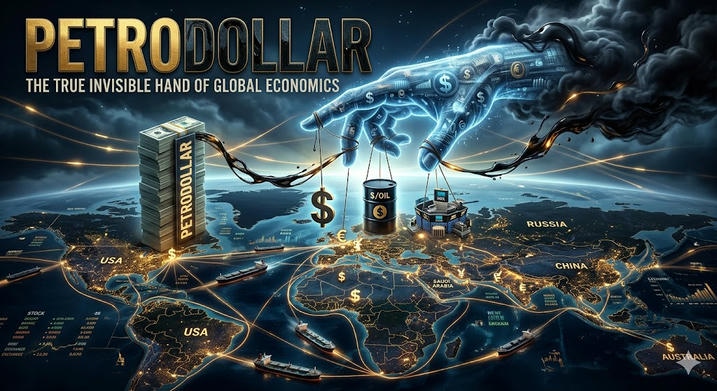

What is the invisible system that controls nearly every trade on the planet?
It is not the pricing mechanism that equates supply and demand. It is not the USA’s central bank, which is called the Federal Reserve. It is certainly not the global stock markets.
It is, in fact, a secret deal made behind closed doors that forces almost every country on Earth to use US dollars whether they want to or not. It is a deal that keeps inflation lower than it should be for American consumers, lets the US government borrow trillions at rates no other country could dream of, and gives America the power to destroy entire economies with a phone call or, more recently, a social media post.
This is the deal that brought about the petrodollar system (Spiro, 1999).
For any management accountant involved with business valuations, corporate finance and enterprise risk management, understanding the system is not optional. It is the foundation underneath everything that countries, corporations, and individuals own—stocks, bonds, houses, retirement plans, etc.—all of which sit on top of this one agreement. Despite this, almost nobody understands its impact, let alone talks about it.
One can be sure that most retail investors have no idea about the risks they take in not understanding its impact and the opportunities they are missing out on. Today, as the conflict between the USA and Israel versus Iran in the Middle East enters its third month and nearly 25% of the world’s oil remains trapped in the Strait of Hormuz, understanding energy flows has become vital for both investors and strategists.
This article is to explain exactly how the petrodollar system works, why it is starting to crack, and most importantly, what the situation means for the global money flows.
Always Follow the Energy Flows
Remember that ‘oil’ is not just petrol (called gasoline in the USA). Oil is everything. Plastic is from oil. The fertiliser that helps grow our food is also made from oil. The cargo ship that brings the cheap furniture and garments from overseas needs oil. The jet fuel flying executives to meetings is also oil.
Every single day, the world burns through about 93 million barrels of oil. Most people do not give much thought as to how dependent everything is on this one material. However, for management accountants in the areas of strategy, risk management, supply chains and investment appraisal, this understanding is vital for sound decision-making.
Example: Take Saudi Arabia. It has more oil than it needs for its consumption. In fact, they need everything else but oil. It needs technology, cars, weapons, and consumer goods. Now, let us take Japan. It is a highly advanced economy that produces incredible products but has no oil whatsoever.
This looks like a good example of what is called a natural trade – Oil for Technology. Japan needs oil. Saudi Arabia needs products that Japan manufactures, such as Toyota cars and similar items. However, it is not that simple.
Now, if Saudi Arabia exchanges oil for Japanese Toyotas without using any currency, the arrangement is considered a ‘barter’ transaction. A good example of this is the ‘Rubber-Rice Pact’, a landmark 30-year barter deal signed in 1952, where Sri Lanka (then Ceylon) exchanged its rubber for Chinese rice. This allowed Ceylon to secure food supplies and China to obtain rubber during Western sanctions.
But Saudi Arabia does not want to only barter Toyotas for its oil. It wants currency – something that can be spent anywhere. But what currency should they accept? Saudi Arabia does not really want Japanese yen. They want something they can spend anywhere, something stable, and something powerful. Japan is not going to accept Saudi riyals for the same reason. Both countries want flexibility. Both want purchasing power.
For over 50 years, the answer as to which currency both countries want has been one thing: the US dollar. Its value comes not from magic or from gold backing. [It has not been backed by gold since President Nixon took it off the gold standard in 1971]. It derives its value because of a very specific agreement made between the United States and the Kingdom of Saudi Arabia. This was the secret agreement, following the 1973 oil crisis, between the United States and Saudi Arabia, formalised in 1974, that created the petrodollar system.
This secret agreement changed everything. More about this deal later.
The Gold Standard
Even before 1974, the US dollar had already become the currency that runs the world. To understand how this situation came about, we need to go back to the end of World War II. Europe was bombed out, devastated. The old powers, Britain, France, Italy and Germany, were in ruins, both economically and physically. Japan was the defeated nation that suffered the impact of two atomic bombs.
But American factories were humming. Except for Pearl Harbour, which brought America into the war, bombs never touched the United States. It had become the world’s manufacturer, the world’s creditor, and the world’s gold vault all at once.
As a result, 44 nations gathered at a resort in Breton Woods, New Hampshire, in 1944. Their mission was to create a new global financial system from scratch. where the US dollar becomes the world’s reserve currency. Other currencies were pegged to the US dollar, which means their exchange rate was fixed and the dollar was convertible to gold at a fixed price of $35 per ounce; i.e., one could walk up to a US bank and exchange dollars for actual gold bars at a fixed rate. Such an arrangement gave everybody confidence. Literally, “The dollar was as good as gold.”
This worked for about 25 years. But then the 1960s happened in the USA. The Vietnam war, together with the ‘Great Society programs” launched by US President Lyndon B. Johnson. These programmes were a sweeping series of domestic initiatives aimed at eliminating poverty and racial injustice in the US. Key programmes included Medicare/Medicaid (1965), the Economic Opportunity Act (1964) and the Civil Rights Act of 1964. These programmes, often called the “War on Poverty”, fundamentally expanded the US federal government’s role in education, healthcare, and civil rights. Government spending in the USA exploded. As a result, countries started noticing something rather uncomfortable. To fund its social programmes and wars, the US was printing way more dollars than it had gold to back them up.
As a result, the French under President Charles de Gaulle started demanding gold in exchange for their US dollars because they saw what was happening. Other countries followed. It was then that on August 15, 1971, US President Richard Nixon announced the temporary suspension of the dollar’s convertibility into gold, effectively ending the Bretton Woods system. This “Nixon Shock” was a response to high inflation, trade deficits, and foreign demands for gold, making the US dollar permanently separate from the gold standard. The long-term impact of this decision was that it ended the fixed exchange rate system established after WWII, and ushered in the era of floating currencies backed by trust rather than gold.
So, just like that, the gold standard was dead.
But the US dollar now had a problem. It was now what we call ‘fiat currency’, basically money backed by nothing except a government saying it is worth something. As a result, for a couple of years after President Nixon’s shock announcement, it was close to chaos in the international currency markets. The US dollar dropped, and other currencies became extremely volatile as nobody really knew what fiat currency meant. Basically, if you took a dollar to a bank, the bank will give you not gold, but a dollar in return.
The Secret Rise of the Petrodollar
Two years after President Richard Nixon took the US dollar off the gold standard and caused currency chaos, in 1973, war broke out in the Middle East. The Yom Kippur War was fought between Israel and Egypt, with Syria also involved, and the US provided weapons to support Israel. At that time, as it is today, the Arab countries had one very powerful card to play: oil. They set up the Organization of the Petroleum Exporting Countries (OPEC) as a cartel of oil-producing countries and announced an embargo of oil for America or anybody supporting Israel. [The similarities today with Iran’s closing of the Strait of Hormuz in its war with the US and Israel are amazing.]
As a result of OPEC sanctions in 1973, almost instantly, oil prices quadrupled in the US. Gas lines stretched for blocks. The American economy fell into a severe downturn. It was a real crisis. President Nixon had to do something about it. He sent Henry Kissinger, the US Secretary of State, to Saudi Arabia with a very simple but interesting proposal:
“Saudi Arabia agrees to sell oil only in US dollars, and the United States agrees that it would provide it military protection and weapons.”
The key details of the agreement were: (1) The Deal: Saudi Arabia agreed to sell its oil exclusively in US dollars; (2) The Return: The US provided military aid, equipment, and security guarantees to the Kingdom; and (3) Petrodollar Recycling: Saudi Arabia agreed to invest its surplus oil revenue (petrodollars) back into the US economy, particularly in US Treasury bonds.
In other words, Saudi Arabia had to make sure everyone needs US dollars to buy its oil, and the USA will make sure nobody messes with it, ever. It was a beautiful deal for both the USA and Saudi Arabia, while everyone else became a ‘forced customer’ of the US dollar. This arrangement solidified the US dollar’s dominance as the global reserve currency. Although this agreement is often described as an informal, long-term pact, the result was that all countries, even Russia and China, could only trade oil in US dollars.
The Global Ecosystem of the Petrodollar
Why was this secret agreement such a good deal for America and the oil-producing Gulf states?
Let us break down how this petrodollar ecosystem exactly operates by going back to our Saudi Arabia and Japan example. Japan needs millions of barrels of oil every single month or day. But they cannot buy oil in yen because, under the deal with the USA, Saudi Arabia will only accept US dollars. Thus, how does Japan obtain dollars? Well, Japan sells its Toyotas, PlayStations, semiconductors, etc. to the USA and the USA pays Japan for these in US dollars.
Now, Japan needs US dollars first before it can buy oil and pay the Saudis with those dollars. They also need US dollars all the time, as ‘oil’ is a constant need for Japan, which burns fuel every day. In case, in any period. Japan does not sell as many cars, etc., as it needs to sell to satisfy its constant need for US dollars (to pay for Saudi Arabia’s oil); it must have US dollars handy to meet any shortfall.
As such, Japan needs to keep a substantial amount of US dollars in reserve, ready when needed to buy oil. Japan meets this shortfall by buying US debt (also known as US government bonds or US treasuries), the safest way to hold US dollars.
This causes Japan (and every other oil-importing country) to buy and hold significant amounts of US dollar debt. Meanwhile, the US. Saudi Arabia and the other oil-producing Gulf states are receiving substantial amounts of money from these oil-importing countries. In fact, they are getting far more US dollars than they need. What do they do with all these dollars? They can spend it on social programmes for the middle class in their country and on luxury goods for the rich, but they still will have a massive surplus of US dollars.
What do they do with this surplus? They invest these US dollars right back into the USA.
They buy US shares with it because it has great opportunity. They buy US real estate because they can obtain income from it. They buy US debt with it because it is considered a safe, risk-free security. And of course they buy US weapons. This is called petrodollar recycling because the money flows out to buy oil, and then it flows right back in as an investment. It is a perfect loop, a perfect ecosystem.
Clearly, after President Nixon took the US dollar off the gold standard and caused currency chaos, and after OPEC caused oil prices to quadruple and gas lines in the USA to stretch for blocks, a global trade ecosystem was required by the USA to put it back on top. This was the petrodollar ecosystem.
Weaponizing the US Dollar
The petrodollar system gave America three significant advantages that most retail investors have never ever thought about or heard of.
First, as demonstrated above, almost every country that imports oil must hold US dollars, not because they love America, but because they literally need it to buy energy. This creates a constant structural demand for dollars that has nothing to do with the state of the US economy. This permanent demand means the US dollar stays stronger than it should be, simply due to this secret agreement. As a result, an American consumer’s purchasing power, especially for imports, is artificially boosted; e.g., the iPhone manufactured in China is cheaper than it should be because of the petrodollar.
Second, because all energy-dependent countries need to hold US dollars, the safest way to hold surplus dollars in reserve is to buy US government bonds. As such, there is this massive permanent demand for US debt. This results in the US government being able to borrow at very low interest rates compared to what other countries can offer for US dollars. This means that the US can spend more on government programmes, lower taxes, and run larger deficits without facing any immediate consequences. For US investors, when US bond rates stay low, they invest more money into stocks and shares, real estate, and riskier assets. This is why all these assets have grown exponentially in the last few decades. The petrodollar is the invisible force that is making that possible.
Third, and this is one of the most powerful and dangerous consequences for the rest of the world of the USA controlling the currency that everybody needs, is that it gives the USA the advantage of being able to ‘weaponise the US dollar’. The USA can cut anyone off from the global economy. This is why US sanctions are so devastating, while the sanctions imposed by other countries barely matter. When the US sanctioned Russia in 2022, it did not invade it. They simply said, “You can’t use dollars anymore,” and suddenly, all Russian banks could no longer trade, and Russian companies could no longer pay suppliers.
Clearly, the USA needs all countries to trade energy in US dollars; otherwise, it will face dangerous consequences.
First, if demand for the US dollar gradually decreases because countries are trading energy in other currencies, the US dollar will weaken, and imports are going to become more expensive for the US consumer. Foreign investments will perform better in dollar terms, and US purchasing power will erode. Second, if the foreign buyers buy less US debt, the US will have to pay a higher interest rate to attract buyers. As a result, the mortgages for USA housing buyers will become more expensive. Corporate borrowing costs in the USA will rise, and stock valuations will decline. Third, if countries can trade without dollars, American sanctions and American banks will have a lot less power. That changes the geopolitical equation, and it creates uncertainty, which is something the market hates (Eichengreen, 2011).
The Push-Back
We have shown how the US has the power to economically destroy a country without firing a single bullet. Now, if you are an American citizen, you might think, “What’s the problem?”
The problem is that other countries have noticed. China, Russia, India, Brazil, Saudi Arabia, and Iran have all observed American policy weaponising the dollar and have considered taking action and developing a backup plan. China and Russia have started trading oil in Yuan (or Renminbi), the Chinese currency. India is paying for Russian oil in Rupees. After the 50-year Security Cooperation Memorandum expired on June 9, 2024, it appears that the petrodollar agreement has also ended, as Saudi Arabia, America’s original partner in the secret deal, is now openly discussing selling oil in other currencies.
Now if the US loses its earlier monopolistic privileges of the petrodollar, there are some intended and unintended consequences. Countries in emerging markets and commodity exporters will benefit from a weaker dollar. Furthermore, if countries are trying to use fewer dollars because they would rather not be that dependent on the US, another long-term consequence is less dependence on oil. Energy transition from oil to renewables may result not because of climate change but due to the need to break free from the petrodollar system by generating their own energy. That means companies will consider green technologies such as building renewable infrastructure, battery storage, LNG facilities and even nuclear plants, and these projects would be where the investment money would flow.
Why has the petrodollar system not collapsed yet?
The first reason is momentum. The global financial system is very slow to change. Trillions of dollars in contracts are still written in US dollars. Pricing systems, banking infrastructure, and accounting standards – they are all built around the dollar. So switching is complicated, expensive and risky.
The second reason is that the dollar is not just backed by economic might. It is backed by military strength – 11 aircraft carriers and 750 military bases around the world. Therefore, countries consider the consequences before challenging a system. They remember what happened to Libya and Iraq when they tried to sell oil in non-US dollars. More recently, Venezuela and Iran were two countries that were selling oil in non-US dollars. There was military intervention in all these counties, supposedly for reasons other than oil trading, such as weapons of mass destruction, drug trafficking, and uranium enrichment.
The third reason is that there is no real alternative yet. Europe still cannot agree on a fiscal policy. Bitcoin is not there yet. This situation leaves only the Chinese currency and the creation of a ‘Petroyuan’ as the sole remaining global option.
The Dual Life of the Yuan
China has created the dual structure of the yuan market. (1) CNY (Onshore) is the yuan inside mainland China. It is a “high-walled fortress”, with its value strictly managed by the People’s Bank of China (PBoC) within a narrow 2% trading band; and (2) CNH (Offshore) is the yuan that trades much more freely in global centres like Hong Kong. The PBoC does retain tools to manage this value and, at times, does intervene to prevent too large a spread in the CNY market. The US dollar is, however, still the ammunition China needs to defend its currency and pay for many of its essential imports, and as such, China built a massive stockpile of US dollar foreign exchange reserves.
Now, China can print yuan to pay Russia and Saudi Arabia for oil. This seems like a shield. But until the ‘petroyuan’ becomes a global alternative to the petrodollar, Russia and Saudi Arabia must eventually convert a large portion of those yuan savings into US dollars to pay for their own global trade. This conversion process adds a massive, additional wave of US dollar selling pressure on the offshore CNH market, accelerating the very currency collapse China is trying to prevent. Remember, China does not have a finite stockpile of US dollars in its foreign exchange reserves. In March 2026 alone, those reserves fell by $85.7 billion, the largest single-month drop in a decade (SAFE, 2026).
As such, there is a credible theory that West did not just fail to stop the rise of the Petroyuan—it actively engineered its creation. The argument is that by cutting Russia off from SWIFT and freezing its dollar assets, the West left Moscow with no choice but to embrace the yuan as its primary foreign currency.
The People’s Bank of China (PBoC) had spent decades fortifying the yuan against a currency attack behind strict capital controls. The central logic was that no speculative assault would be able to breach the defences. So, the theory is that the Western strategy was to lure the defenders (i.e., the PBoC) outside into the open.
When Russia intervened in Ukraine, the collective West responded with a financial firestorm. Sanctions, SWIFT exclusion, and asset freezes. By doing so, they created an irresistible temptation for China to internationalise its currency in the form of the Petroyuan. China believed it was building the financial infrastructure for a multipolar world; in reality, the theory goes that they were inadvertently creating a financial battering ram that would be used to try and breach the walls of the onshore yuan fortress. With every barrel purchased, the enemy receives more ammunition. The more oil is traded in yuan, the less defence the walls of capital controls offer.
In other words, by excluding Russia from the SWIFT payment system and forcing it to face restricted use of dollars and euros, it was forced to pivot towards the Chinese yuan as a lifeline. As such, the view is that the Petroyuan was not a Chinese victory but that it was a Western trap (Tan, 2025).
The Thucydides Trap
If the Petroyuan was a trap actively engineered by the West, then it may lead to a bigger trap, referred to as the Thucydides Trap. Harvard professor Graham Allison describes this trap as the dangerous structural stress that occurs when a rising power threatens to displace an established ruling power, often leading to war (Allison, 2017). This phenomenon is as old as history itself and explains the Peloponnesian War that devastated ancient Greece. As the historian Thucydides explained: “It was the rise of Athens and the fear that this instilled in Sparta that made war inevitable.”
Professor Allison (2017) shows that over the past 500 years, similar conditions have occurred sixteen times and that war broke out in twelve of them. He says that the seventeenth case looks grim unless China is willing to scale back its ambitions or Washington can accept becoming number two in the Pacific.
Today, as an unstoppable China approaches an immovable America, President Xi Jinping warned of the need to avoid this Thucydides Trap in his introductory speech at the Summit meeting with President Donald Trump in May 2026 in Beijing. It is not clear if President Trump understood this historical reference, but the world is today in such a dangerous geopolitical situation that a trade conflict, cyberattack, or accident at sea could soon escalate into all-out war.
Impact of Recent Geopolitical Tensions on the Petrodollar
For the first time since WWII (excluding the pandemic), the U.S. public debt ($31.27 trillion) has officially exceeded its GDP ($31.22 trillion). This shifts global confidence in the US economy from a long-term fiscal concern to an immediate economic threat (Ugalde and Braun, 2026).
The petrodollar system only works on the condition that Gulf states keep sending money back into US markets. However, Iran’s pressure campaign on Gulf states, including attacks on their economic assets and leveraging of the Strait of Hormuz, is creating uncertainty in oil markets, government budgets and regional stability. As such, swap lines have reversed the above condition – dollars must now flow to the Gulf instead of from it.
The key drivers of the current crisis are geopolitical instability and capital flight risk. Gulf states are reassessing their reliance on US markets due to wavering confidence in US protection following military escalations involving Israel and Iran. The Gulf Cooperation Council (GCC) holds approximately $2 trillion in U.S. assets. Major economies in this region are already reviewing their positions, creating the potential for a massive selloff.
The result is a liquidity paradox. The US cannot easily block these sell-offs because the market’s primary appeal is its openness; restricted exits would destroy the very “liquidity” that attracts investors in the first place. This scenario creates an economic “chain reaction”. The US economy is currently sustained by stretched asset valuations (stocks, bonds, and real estate) that exceed their fundamental value. If foreign holders trigger a run, it could result in a price collapse with a mass selloff that would cause asset prices to plummet. There would also be collateral damage, with falling prices reducing the value of collateral held by leveraged institutions. Such a scenario will bring about financial contagion; i.e., to cover losses, institutions would cut borrowing and sell more assets, creating a downward spiral that spreads financial stress globally, mirroring the mechanics of the 2008 financial crisis.
Conclusion
The petrodollar system, which was set up as a strategic partnership between the US and Saudi Arabia, has been a key part of the global economy for decades. It has fortified the US dollar’s status as the world’s primary reserve currency, enabling the US to maintain significant economic advantages, such as enhanced purchasing power, low borrowing costs, and geopolitical leverage through the ability to impose effective economic sanctions.
However, the system is facing increasing challenges. Countries like China, Russia, and others are exploring alternatives to reduce their dependency on the U.S. dollar. This pushback is driven by the desire to mitigate the risks associated with the weaponization of the dollar and to gain more autonomy in global trade. The emergence of the petroyuan represents a significant attempt to shift the balance of power, though it also poses risks to the very countries promoting it due to the complexities of currency convertibility and reserve management.
The resilience of the petrodollar system thus far is attributed to the entrenched global financial infrastructure reliant on the dollar, the formidable military backing of the US, and the lack of a fully viable alternative currency. However as geopolitical tensions rise and technological advancements in energy and finance continue to evolve, the future of this system is uncertain. It is critical for investors, strategists, and policymakers to understand these dynamics to navigate potential shifts in global money flows and to capitalise on emerging opportunities in sectors such as renewable energy and technology.
Ultimately, while the petrodollar system has not yet collapsed, its potential destabilisation due to current geopolitics presents both risks and opportunities on the global stage, making it imperative for stakeholders to remain informed and adaptable.
The US dollar is not going to collapse tomorrow, next year, or probably even this decade unless the USA and Israel experience a significant military reversal in their war with Iran. But for the first time since 1974, there is a real alternative emerging to the US dollar, and that has implications for global trade and investment.
Big systems do not collapse overnight. They erode very gradually and then suddenly. Therefore, the petrodollar probably will not end with a headline. It will just matter less year by year, trade by trade. The dollar’s share of global reserves has already declined from about 70% to 58%.
This is not a crisis, but it is a significant trend.
References
Allison, Graham (2017). Destined for War: Can America and China Escape Thucydides’s Trap? Houghton Mifflin Harcourt, 384 pp.
Eichengreen, Barry (2011), Exorbitant Privilege: The Rise and Fall of the Dollar and the Future of the International Monetary System, Oxford University Press, 215pp.
Goodell-Ugalde, Elliot and Braun, Natalie (2026), “How the U.S.‑Israel war against Iran is exposing the limits of the petrodollar system”, The Conversation, May 13. https://theconversation.com/how-the-u-s-israel-war-against-iran-is-exposing-the-limits-of-the-petrodollar-system-282226.
SAFE News (2026), “SAFE Releases Data on China’s Foreign Exchange Reserves at the end of March 2026″, State Administration of Foreign Exchange, April 7. https://www.safe.gov.cn/en/2026/0407/2413.html.
Spiro, David E. (1999) The Hidden Hand of American Hegemony: Petrodollar Recycling and International Markets, Cornell University Press, 208 pp.
Tan, Dongan (2025), The Decoupling Dilemma: How US Sanctions Erode Global Economic Governance, Cambridge University Press 20 November. https://www.cambridge.org/core/journals/international-organization/article/decoupling-dilemma-how-us-sanctions-erode-global-economic-governance/8FA0868798CE6033CBAF995F0E763084.